How to Get Rid of German Cockroaches: Baits, IGRs, No Bombs
Contents
- How to get rid of German cockroaches: start with these 7 steps
- How to identify German cockroaches: two dark stripes, about 1/2 inch long
- Gel baits: why many pea-sized dots beat a few big globs
- IGRs: the part of the plan that stops the next generation
- Bait rotation and resistance: switch active ingredients after 2–3 weeks
- What doesn’t work (and why)
- When to call a professional
- Keep them from coming back: water, cracks, and what you carry in
The way to get rid of German cockroaches is to bait them, not spray them: put many small dots of gel bait in the cracks where they hide, add an insect growth regulator (IGR) to stop the next generation, take away their food and water, and switch to a different bait if the population hasn’t dropped in 2 to 3 weeks. Foggers and most store-bought sprays make things worse.
What works: gel baits in many pea-sized dots, an IGR, sticky traps to track progress, and strict kitchen cleanup.
How long: baited roaches die in 1 to 3 days; expect a clear drop within a few weeks and full control over several weeks of follow-up.
When to call a pro: no improvement after two different baits, roaches seen in daylight, or an apartment building where units share walls.
How to get rid of German cockroaches: start with these 7 steps
German cockroaches spend about 75% of their lives in cracks 1/32 to 3/16 inch (1 to 5 mm) wide, according to Texas A&M AgriLife Extension. Your plan has to reach those cracks.
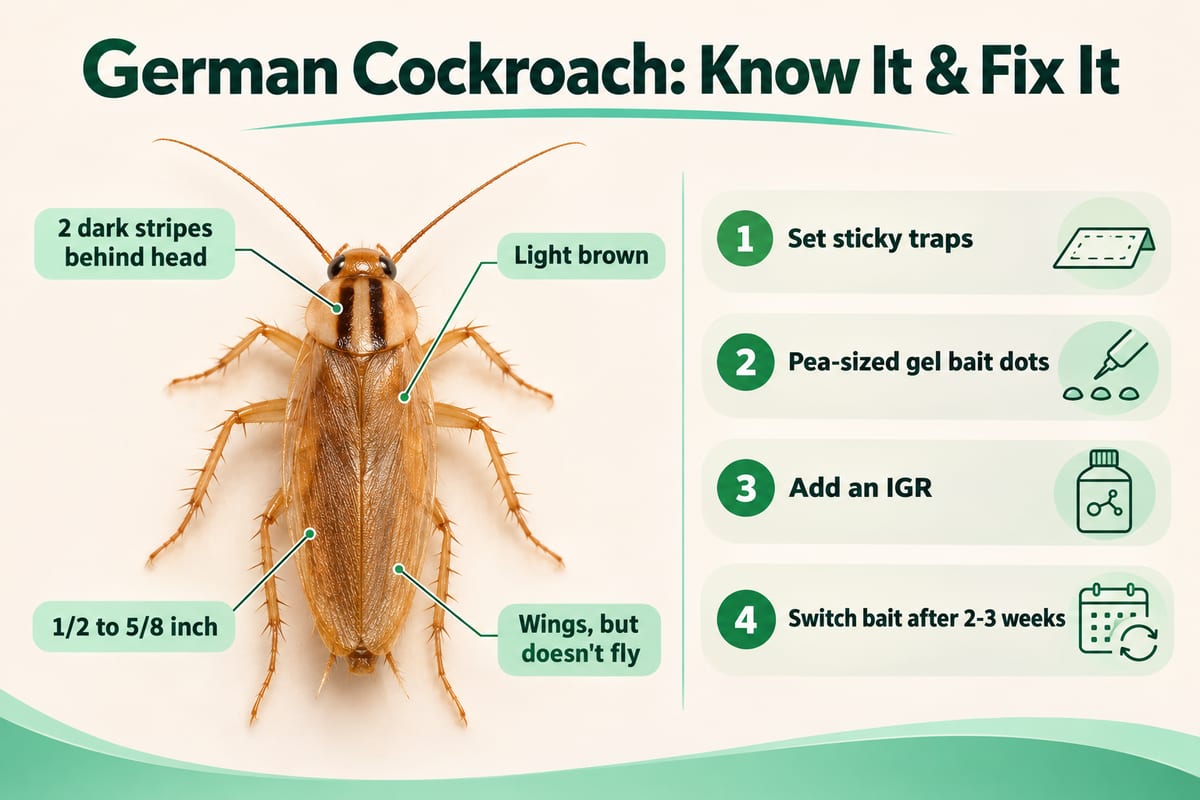
- Confirm it's a German cockroach. Look for a light brown roach about 1/2 inch (13 mm) long with two dark stripes behind the head (details below). Other roaches need a different plan.
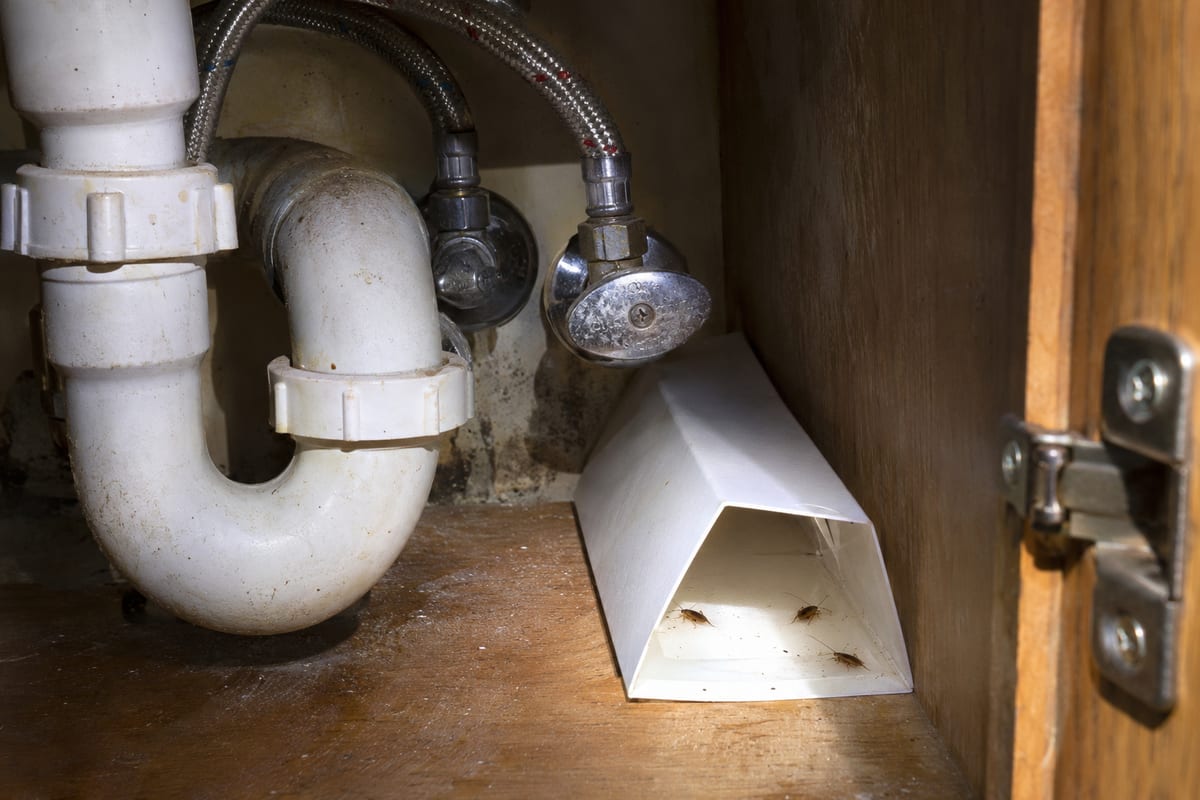
- Find the hiding spots. Use a flashlight at night and look for droppings that look like ground pepper near the stove, refrigerator, dishwasher, sink cabinet, and trash.
- Put out sticky traps. Place them along cabinet edges, under the sink, and behind appliances. Count the catch weekly so you know whether the plan is working.
- Apply gel bait in many small dots. Put pea-sized or smaller dots in cracks, hinges, and corners near every hiding spot. Bait stations should sit within 1 to 2 feet (30 to 60 cm) of each harborage.
- Add an IGR. Use an IGR product (hydroprene or pyriproxyfen are the common active ingredients) as the label directs, so nymphs can't grow into breeding adults.
- Starve them. Wipe crumbs and grease, store food in sealed containers, take trash out nightly, empty pet bowls at night, and fix drips.
- Check, refill, and switch if needed. Replace eaten or dried bait. If trap counts haven't dropped after 2 to 3 weeks, switch to a bait with a different active ingredient.
How to identify German cockroaches: two dark stripes, about 1/2 inch long
German cockroach adults are 1/2 to 5/8 inch (13 to 16 mm) long and light brown, with two dark stripes running lengthwise on the shield behind the head (the pronotum). They have wings that reach the end of the body, but they don’t fly. Nymphs are darker, with a pale stripe down the middle of the back.
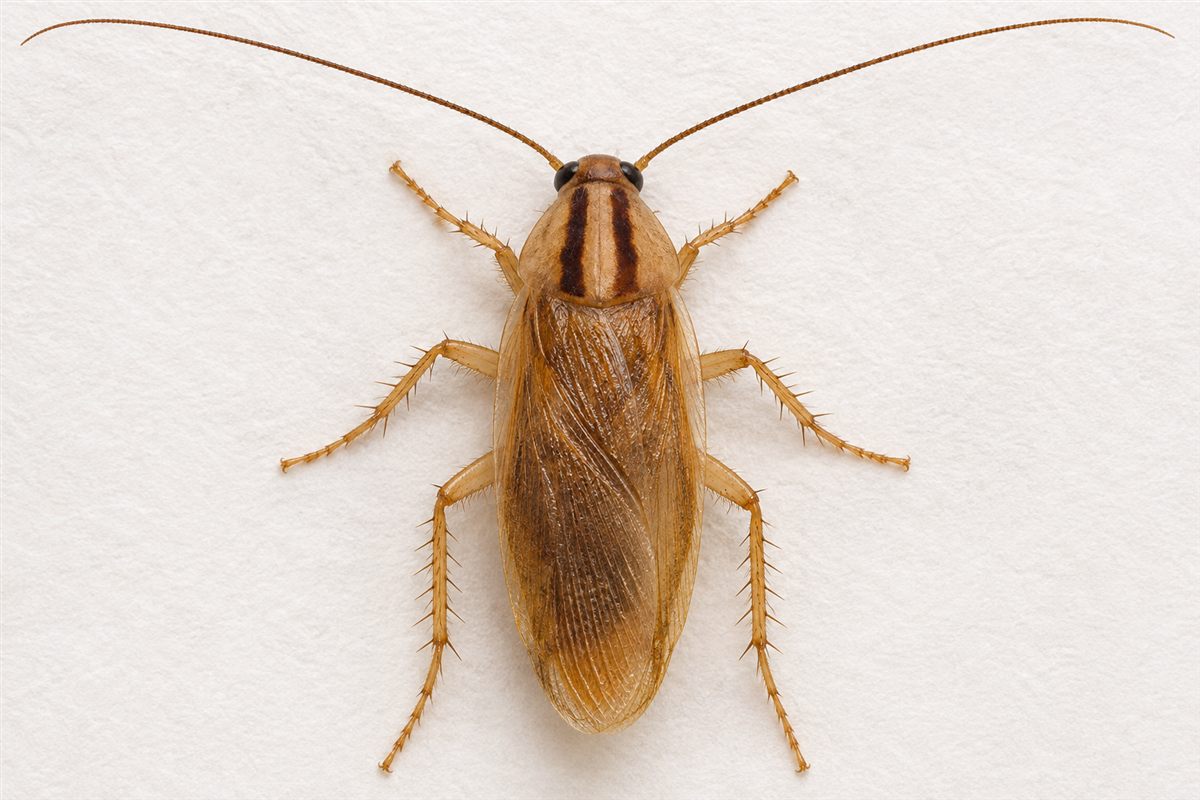
ID matters because the large roaches you see near drains or porches live mostly outdoors and come inside by accident. German cockroaches live entirely indoors and breed there.
| Roach | Adult size | Look | Where it lives |
|---|---|---|---|
| German | 1/2–5/8 in (13–16 mm) | Light brown, two dark stripes behind head | Indoors only: kitchens, bathrooms |
| American | 1 1/2–2 in (38–51 mm) | Reddish brown, pale band around the shield behind head; flies | Mostly outdoors, sewers, basements |
| Oriental | About 1 1/4 in (32 mm) | Dark brown to black, short wings | Cool, damp, ground-level spots |
| Smokybrown | 1 1/4–1 1/2 in (32–38 mm) | Uniform dark brown to black | Outdoors: mulch, trees, eaves |
| Asian | Similar to German | Nearly identical stripes | Outdoors in some southern areas |
Source: Texas A&M AgriLife Extension, Cockroach Biology and Management (E-359).
German cockroaches also multiply fast. Each egg case produces 30 to 40 nymphs, nymphs reach adulthood in 50 to 60 days at normal indoor temperatures, and a generation can turn over in about 100 days (Texas A&M). Seeing them during the day usually means a large population.
Gel baits: why many pea-sized dots beat a few big globs
Baits are a food mixed with insecticide. Roaches eat them and go back to their hiding places to die. Texas A&M lists baits among the most effective cockroach insecticides for homes, and the University of Kentucky notes that a roach typically dies within 1 to 3 days of feeding.
Common bait active ingredients include fipronil, indoxycarb, dinotefuran, abamectin, and hydramethylnon. Brand names change, so read the active ingredient on the label.
How to place gel bait well:
- Go small and many. Many dots no larger than a pea work better than a few large ones (Texas A&M). Don’t over-apply so the bait drips or sits in plain view.
- Go where they live. Hinges of cabinet doors, the gap behind the stove and refrigerator, under the sink, around the dishwasher, and near trash cans.
- Keep it clean. Don’t spray cleaners or insecticides on or near the bait. Texas A&M notes that roaches avoid contaminated bait.
- Keep it fresh. Check baits regularly, refill eaten spots, and scrape off old, dried bait.
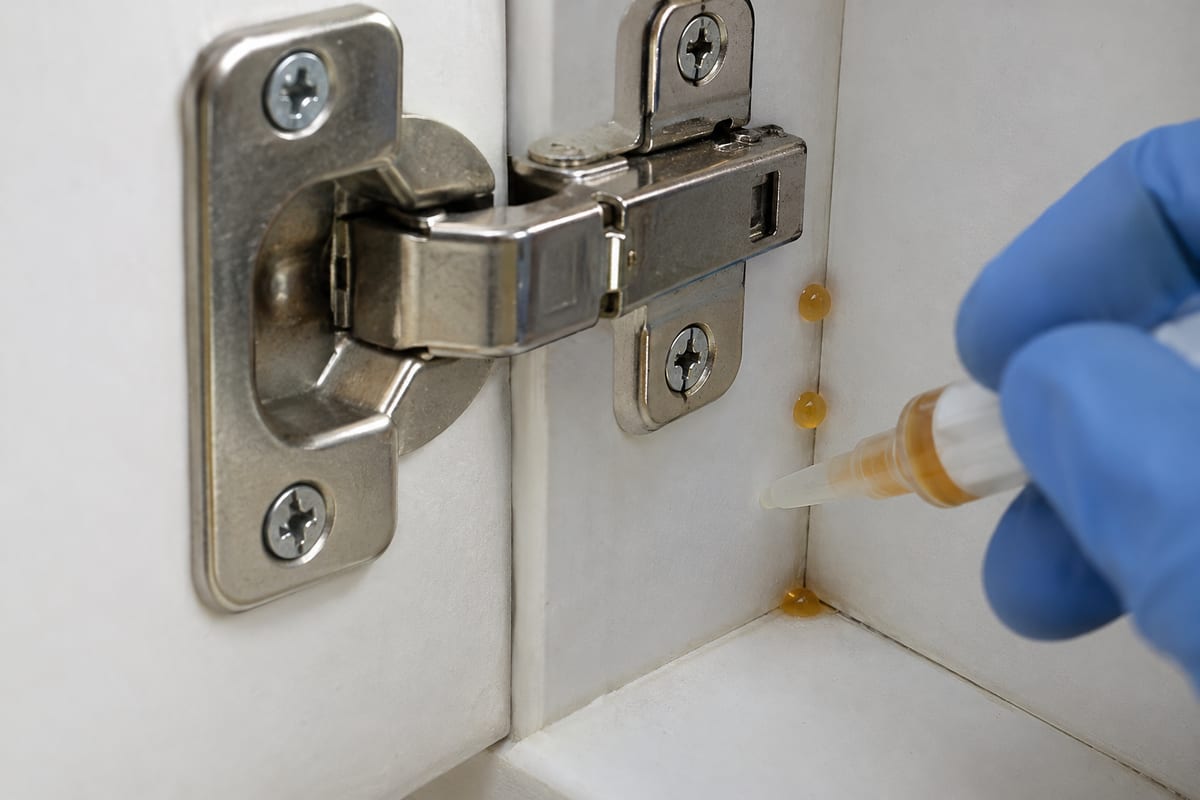
Baits work best when there’s little else to eat. That’s why cleanup isn’t optional. Wipe grease from the stovetop and range hood, sweep under appliances, and use a vacuum with a HEPA filter to pick up roaches, droppings, and shed skins that can trigger allergies and asthma.
IGRs: the part of the plan that stops the next generation
Insect growth regulators mimic insect hormones. The National Pesticide Information Center explains that IGRs are rarely fatal to adult insects, but they keep young insects from developing normally and can sometimes leave adults sterile. For cockroaches, the common IGR active ingredients are hydroprene and pyriproxyfen.
An IGR won’t make the roaches you see today disappear. It’s a backup that keeps nymphs from becoming breeding adults while baits kill the active population. A sign it’s working is adults with crumpled or twisted wings in your traps.
Read the label to confirm a product contains an IGR. NPIC notes that IGRs are generally low in toxicity to people, but you still need to follow the label on where and how much to apply.
Bait rotation and resistance: switch active ingredients after 2–3 weeks
German cockroaches adapt fast. Two research findings explain why the same product can stop working.
Insecticide resistance. In a 2019 Purdue University field study in multi-unit buildings in Indiana and Illinois, resistance rose four- to six-fold in a single generation, and roaches picked up cross-resistance to insecticide classes they had never been exposed to. Rotating three insecticides month by month held populations flat but didn’t reduce them. Mixing two insecticides failed, and populations grew. A single product the roaches had little resistance to nearly wiped out one population, but where some resistance was already present, the population grew.
Bait aversion. NC State researchers showed in 2013 that some German cockroach populations have inherited a taste change that makes glucose taste bitter to them. Those roaches refuse baits made with glucose, even though the insecticide in them would still kill them.
What this means for you:
- If trap counts aren’t falling after 2 to 3 weeks, switch to a bait with a different active ingredient, not just a different brand. Texas A&M recommends switching active ingredients regularly.
- If roaches walk past fresh bait without eating, the problem may be the bait base, not the poison. A bait with a different food formula can work.
- Don’t layer several products at once. The Purdue study (published in Scientific Reports) suggests mixing doesn’t help and can backfire.
- Combine chemistry with traps, sanitation, and vacuuming. The Purdue lead researcher said combining several methods is the most effective approach.
What doesn’t work (and why)
Bug bombs (total-release foggers). NC State tested four over-the-counter foggers in 20 infested homes in a 2019 study. Cockroach numbers did not drop at two weeks or one month. Gel baits tested in 10 homes eliminated the populations. The foggers also raised insecticide residue on horizontal surfaces by about 600 times on average within hours, and 34% of surfaces still had elevated residue a month later. The fog settles on open surfaces and never reaches the cracks where roaches hide. The University of Kentucky adds that fogger ingredients tend to be repellent and drive roaches deeper into wall voids.
Spraying roaches and baseboards. Texas A&M notes that pyrethroids, the most common store-bought spray ingredients, are highly repellent to German cockroaches, and that sprays are not nearly as effective as baits. Spray scatters the colony, and drift near bait makes roaches refuse it.
Sticky traps alone. Traps are excellent for monitoring but won’t control an established infestation (Texas A&M).
Piles of boric acid or diatomaceous earth. Roaches avoid heavy dust deposits. Boric acid works only as a thin, barely visible layer in voids and cracks. The University of Kentucky rates boric acid as more effective than diatomaceous earth. Never put either on countertops or open shelves.
Waiting it out. A single mated female can lead to thousands of roaches in less than a year (University of Kentucky). The population won’t fade on its own while food and water are around.
When to call a professional
Call a licensed pest control company if:
- Trap counts haven’t fallen after you’ve tried two baits with different active ingredients.
- You see roaches in daylight or in rooms far from the kitchen, a sign of a large population.
- You live in an apartment or attached home where roaches move between units. Treating one unit alone often fails. Our guide to getting rid of roaches in an apartment covers working with your landlord.
- Someone in your home has asthma or allergies, so you need fast control with minimal dust and residue.
A good pro will inspect first, use baits, IGRs, and dusts in cracks rather than broadcast spraying, and come back to check traps. The University of Kentucky points out that it shouldn’t take a full year to eliminate cockroaches, so be wary of long contracts that promise only “management.”
Keep them from coming back: water, cracks, and what you carry in
German cockroaches usually arrive in grocery bags, cardboard boxes, used appliances, or from a neighboring unit. Check boxes before you bring them inside and recycle cardboard quickly.
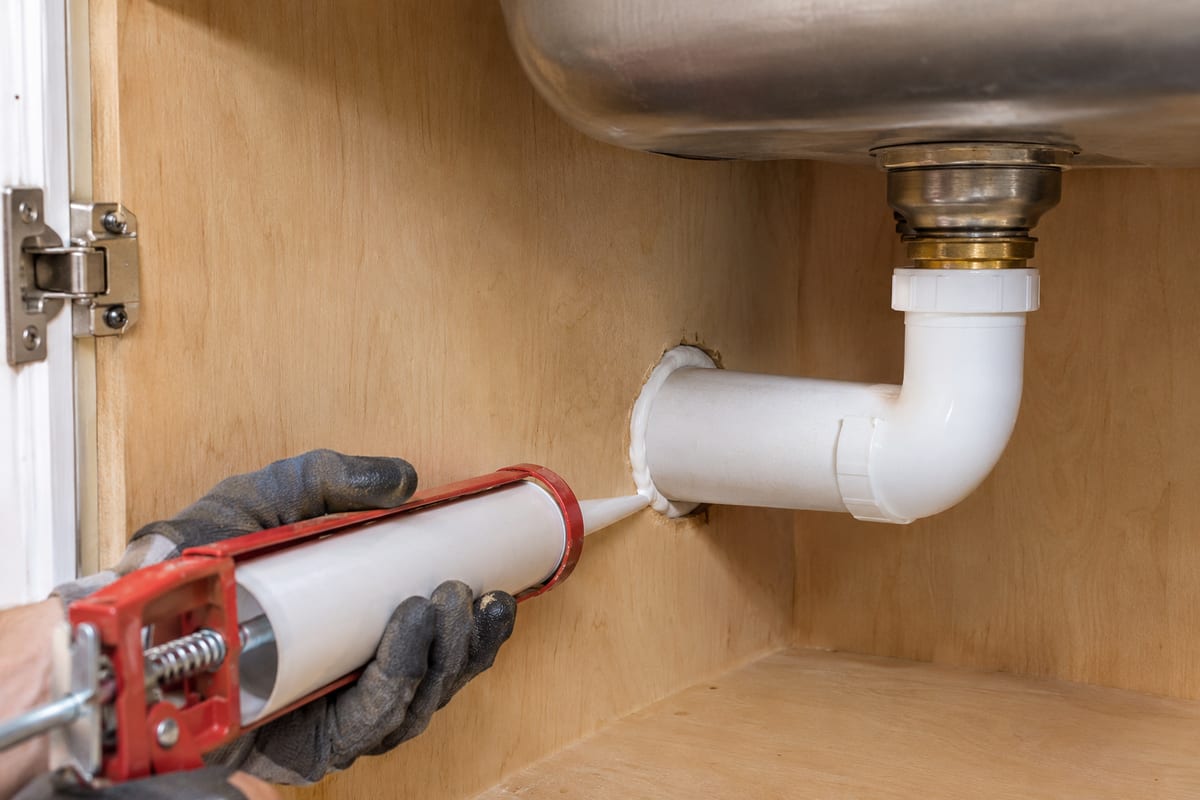
Fix leaks under sinks and around the dishwasher, since roaches need water daily. Seal gaps around plumbing, along backsplashes, and behind the sink with good caulk. The same moisture fixes that help with silverfish in the bathroom also make the room less friendly to roaches. Keep a few sticky traps out permanently under the sink and behind the fridge as an early warning.
Closing checklist
- Confirmed: light brown, about 1/2 inch, two dark stripes behind the head.
- Sticky traps out and counted weekly.
- Gel bait in many pea-sized dots within 1 to 2 feet of every hiding spot.
- IGR added per the label.
- No sprays, cleaners, or foggers near the bait.
- Food sealed, crumbs and grease gone, leaks fixed, trash out nightly.
- No drop in 2 to 3 weeks: switch to a different active ingredient.
- Still no progress after two baits: call a professional.
Frequently asked questions
Do German cockroaches ever go away on their own?
No. German cockroaches live entirely indoors, and a generation can mature in about 100 days, so an infestation keeps growing as long as there's food, water, and shelter. They go away only when you remove their food and water and kill them with baits and other targeted treatments.
How long does it take to get rid of German cockroaches?
Roaches that eat bait usually die within 1 to 3 days, and you should see a clear drop within a few weeks. If a bait isn't working after 2 to 3 weeks, switch to one with a different active ingredient. A full cleanup of a heavy infestation often takes several weeks of follow-up, but it shouldn't take a year.
How do you get rid of German cockroaches in the kitchen?
Put many small dots of gel bait in cracks near the stove, refrigerator, dishwasher, sink cabinet, and trash can, then remove competing food: wipe crumbs and grease, store food in sealed containers, and fix drips. Keep sprays and cleaners off the bait spots, and use sticky traps to see where activity is highest.
Does boric acid kill German cockroaches?
Yes. Texas A&M AgriLife Extension calls boric acid one of the more effective cockroach insecticides when used properly. Puff a thin, barely visible layer into wall voids, under appliances, and around pipes, never on countertops or open shelves, and follow the label.
Why do German cockroaches keep coming back after spraying?
Many store sprays contain pyrethroids, which German cockroaches tend to avoid, so roaches scatter deeper into walls instead of dying. Many populations are also resistant to common insecticides. Spray residue can contaminate nearby baits so roaches refuse them.
How do exterminators get rid of German cockroaches?
Professionals inspect with traps and flashlights to find harborages, then rely mainly on gel baits, insect growth regulators, and dusts placed in cracks and voids. They rotate bait active ingredients when a population stops responding, and come back to check traps and reapply.
Sources
- Texas A&M AgriLife Extension — Cockroach Biology and Management (E-359)
- University of Kentucky Entomology — Cockroach Control (ENTFACT-614)
- NC State University — 'Bug bombs' are ineffective (DeVries et al., BMC Public Health, 2019)
- Purdue University — Rapid cross-resistance bringing cockroaches closer to invincibility (2019)
- NC State University — Glucose-averse cockroaches (Wada-Katsumata et al., Science, 2013)
- National Pesticide Information Center — Insect Growth Regulators
- National Pesticide Information Center — Pyriproxyfen General Fact Sheet
- Fardisi et al. — Rapid evolutionary responses to insecticide resistance management interventions by the German cockroach (Scientific Reports, 2019)
- U.S. EPA — Introduction to Pesticide Labels