Condensation on Walls: What Causes It and How to Stop It
Contents
- Condensation on walls: what to do right now
- What causes condensation on walls: dew point in plain English
- Cold exterior walls and corners: where condensation shows up
- How to stop condensation on walls: cut the moisture, then warm the wall
- Condensation vs leak vs rising damp: the foil test
- What doesn’t work (and why)
- When to call a professional
- Closing checklist
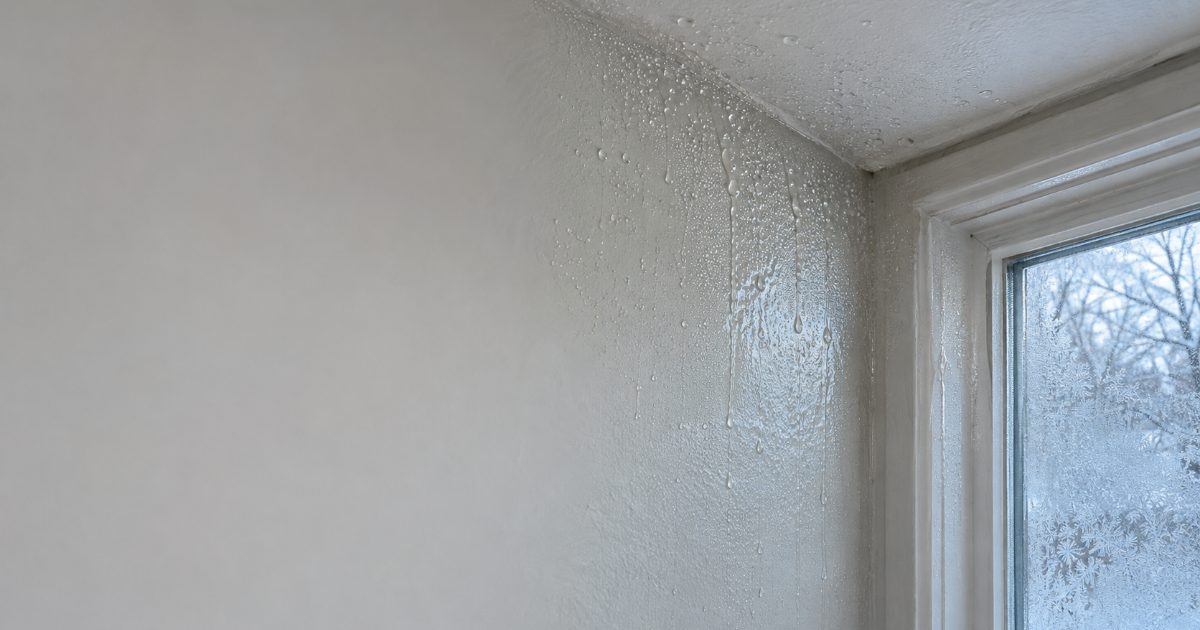
Condensation on walls happens when warm, humid indoor air touches a wall that is colder than the air’s dew point, so the fix is to lower indoor moisture, move air across cold surfaces, and make those surfaces warmer.
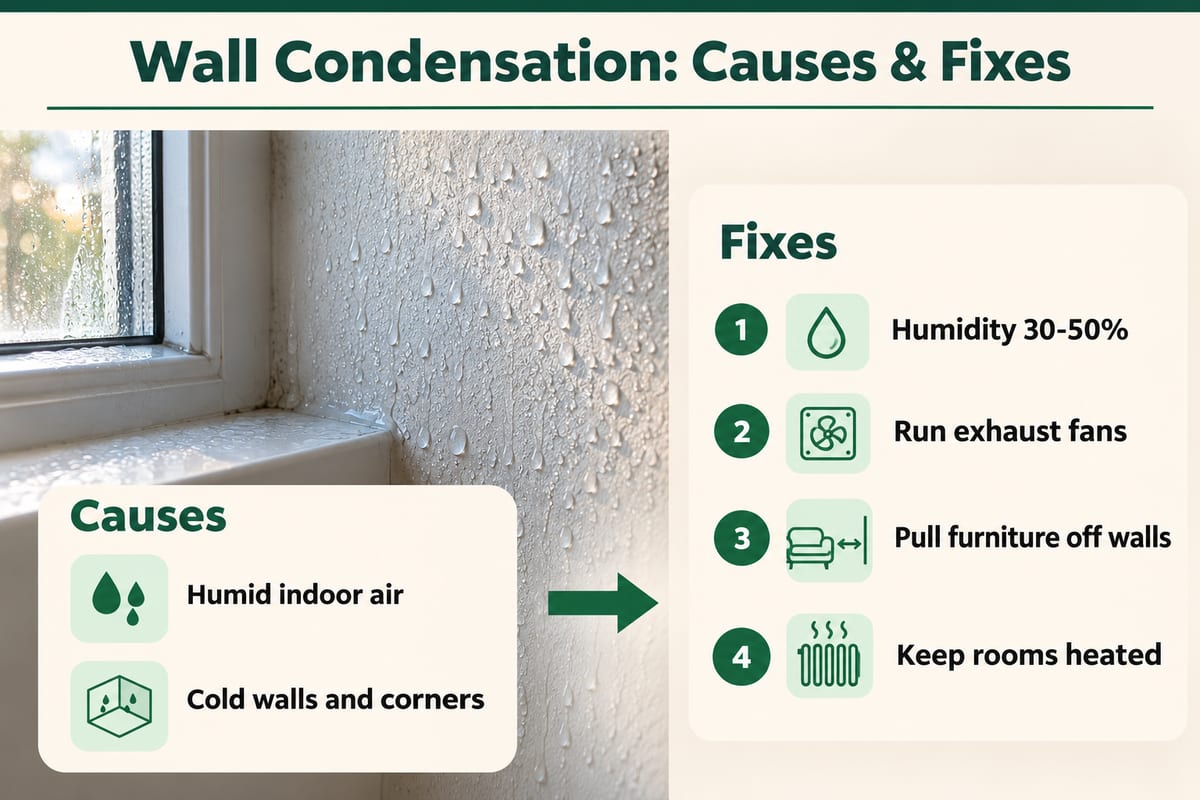
- What works: humidity at 30–50%, exhaust fans that vent outdoors, air moving across cold walls, better insulation.
- How long: venting and dehumidifying cut condensation within days; insulation fixes are permanent but take a project.
- Call a pro: walls stay wet after humidity is under control, mold covers more than about 10 sq ft, or you suspect a leak.
Condensation on walls: what to do right now
Wet walls need two things fast: dry the surface, then lower the moisture in the air. Mold usually won’t grow if damp materials are dried within 24–48 hours, according to EPA guidance.
- Wipe the water off with a dry towel or squeegee, including window sills and the bottom of the wall.
- Check the humidity with a digital hygrometer. Over 50% means the air is carrying too much water.
- Run exhaust fans in the bathroom and kitchen during and after showers and cooking. Make sure they vent outdoors.
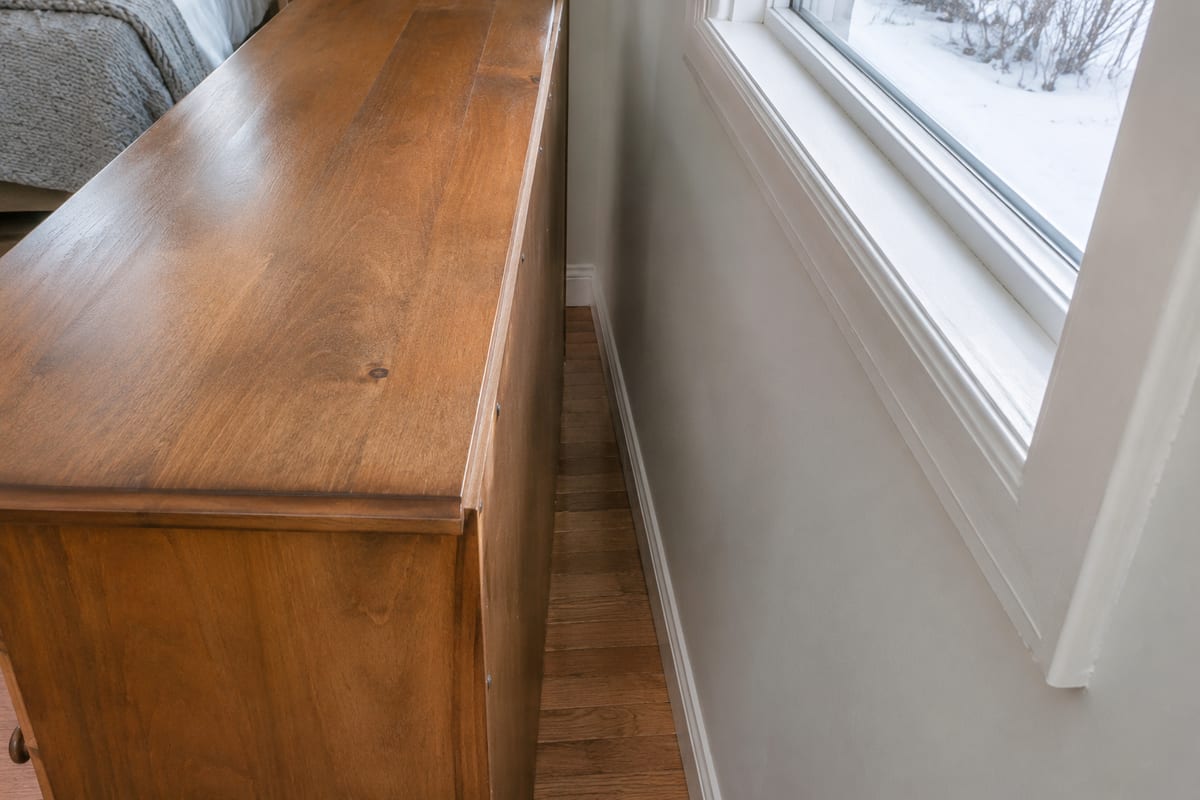
- Pull furniture away from outside walls, ideally a few inches, so warm room air can reach the wall.
- Keep the room heated evenly. Very cold rooms and deep thermostat setbacks make walls colder.
- Run a dehumidifier if humidity stays high, with the doors and windows to that room closed.
What causes condensation on walls: dew point in plain English
The National Weather Service defines dew point as the temperature air must be cooled to in order to reach 100% relative humidity. Below that temperature, the air can’t hold all its water vapor, and the extra turns into droplets on whatever is cold.
Here is what that means at home. Room air at 70°F (21°C) and 50% humidity has a dew point of about 50°F (10°C). Any wall surface at or below roughly 50°F gets wet. Drop the room to 30% humidity and the dew point falls to about 37°F (3°C), so the same wall stays dry.
| Room air at 70°F (21°C) | Approximate dew point | What it means |
|---|---|---|
| 30% relative humidity | 37°F (3°C) | Only very cold surfaces get wet |
| 40% relative humidity | 45°F (7°C) | Single-pane glass and cold corners at risk in winter |
| 50% relative humidity | 50°F (10°C) | Poorly insulated walls and corners start to sweat |
| 60% relative humidity | 56°F (13°C) | Condensation on many cool surfaces, basement walls too |
Dew points calculated with the standard Magnus approximation. Definition: National Weather Service.
EPA building guidance adds a key point: the highest humidity in a room is always right next to the coldest surface. That spot is the “first condensing surface,” and it’s where water and mold show up first. Mold on a corner room’s walls means humidity right at the wall surface is above 70%, even if the middle of the room reads lower.
Cold exterior walls and corners: where condensation shows up
Water doesn’t appear evenly. It collects where the wall is colder than the rest of the room. The EPA lists exterior corners as common mold spots, because they lose heat on two sides, get less air circulation, may have less insulation, and can be cooled by wind blowing through gaps outside.
Typical trouble spots:
- Upper corners where an outside wall meets the ceiling. Insulation often thins out at the edge of the attic.
- Behind beds, dressers, and sofas on outside walls. The EPA notes mold is often found in cold corners behind furniture.
- Closets on exterior walls, packed with clothes and closed off from heat. Musty clothes are often a sign; see our guide to finding the source of a musty smell in your house.
- Thermal bridges, such as steel studs, uninsulated window headers, and the edge of a concrete slab. EPA guidance notes that dust can stick to these cold spots and outline them on the wall.
- Around windows, where the frame and wall meet.
Condensation on walls but not windows
If your windows are double-glazed, they may now be warmer than a poorly insulated wall. The EPA points out that better windows let homes run at higher indoor moisture without the visible window condensation that used to warn people to ventilate. The wall becomes the warning sign instead.
Condensation on walls in summer and from the air conditioner
In humid climates the cold surface is often the one you cooled. EPA guidance describes rooms where AC supply air blows directly on an outside wall, chilling it below the dew point of humid air. Vinyl wallpaper on those walls can trap moisture behind it. Redirect the vent, avoid overcooling, and keep windows closed on muggy days, since outdoor air in summer often holds as much moisture as indoor air.
How to stop condensation on walls: cut the moisture, then warm the wall
Start with the water you put into the air, because it’s the cheapest fix and works in every home. Then deal with walls that are simply too cold.
Moisture sources: a family of four adds about 6 gallons a day
Montana State University Extension estimates that an average family of four can add over six gallons of water to indoor air each day. Their breakdown shows where it comes from:
| Activity | Moisture added per day |
|---|---|
| Clothes dryer vented indoors | 26.4 lb (12 kg) |
| Breathing and perspiring (4 people) | 16.8 lb (7.6 kg) |
| Washing clothes | 4.3 lb (2 kg) |
| Mopping floors | 2.4 lb (1.1 kg) |
| Cooking on an electric range, no vent | 2.0 lb (0.9 kg) |
| Showers or baths | 2.0 lb (0.9 kg) |
| Washing dishes by hand | 1.0 lb (0.5 kg) |
| House plants | 1.0 lb (0.5 kg) |
| Total | 55.9 lb, about 6.7 gallons (25 L) |
Source: Montana State University Extension, Controlling Condensation in the Home.
Two lessons stand out. A dryer that vents indoors is the single biggest source, and people themselves add a lot, which is why a closed bedroom with two sleepers gets damp overnight. Drying laundry on racks indoors in cold weather adds moisture too.
Ventilation and humidity targets
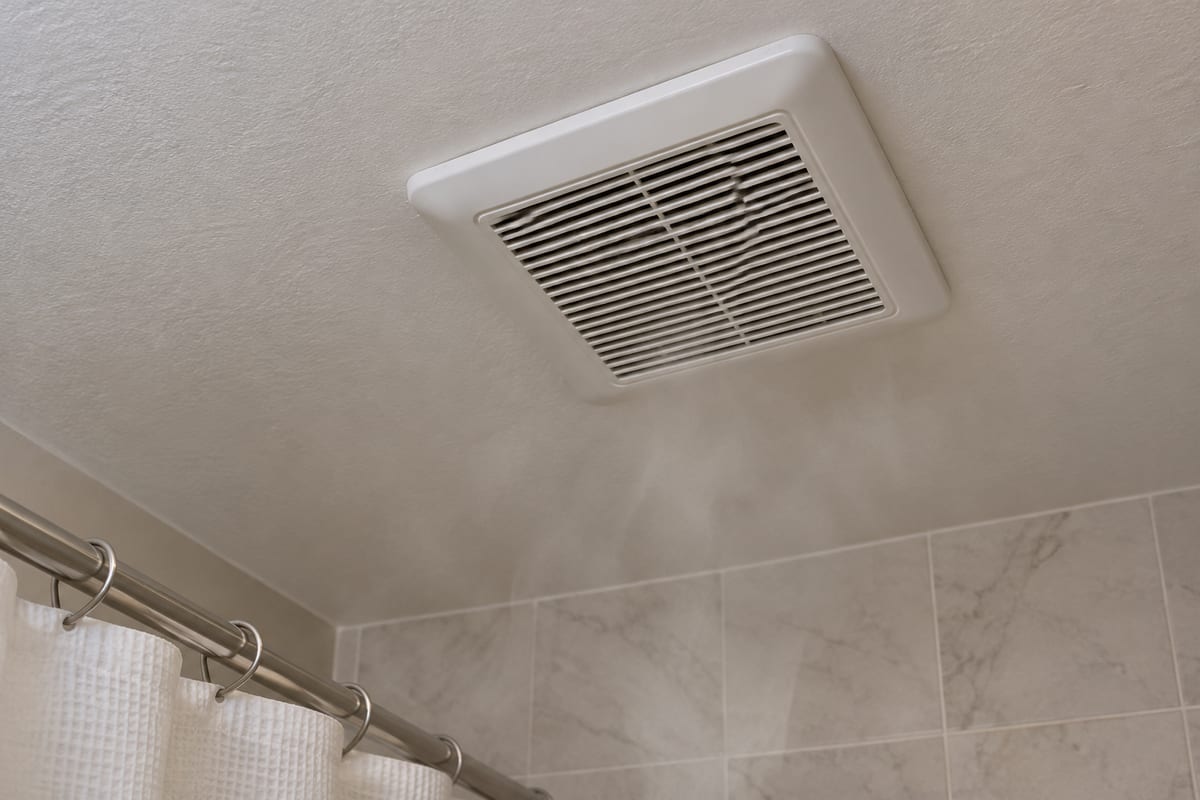
- Use exhaust fans every time. Run the bathroom fan during showers and for a while after, and the range hood while cooking. MSU Extension stresses they must vent outdoors, not into the attic or crawl space.
- Vent the dryer outside. The EPA says clothes dryers should be vented to the outside. Check that the duct is connected and not crushed.
- Cover pots when boiling.
- Open interior doors and use ceiling fans so air reaches cold walls. Don’t block heating registers or returns.
- Air out briefly in winter. Cold outdoor air holds little moisture, so short ventilation lowers indoor humidity in the heating season. It doesn’t work on humid summer days.
- Cover crawl space soil with 6-mil plastic sheeting, as MSU Extension recommends, so ground moisture doesn’t rise into the house.
Target humidity: the EPA recommends below 60%, ideally 30–50%. In cold climates during winter, ENERGY STAR suggests 30–40% to prevent window condensation, and MSU Extension suggests about 30–45%.
Dehumidifier sizing basics
ENERGY STAR rates dehumidifiers by pints of water removed per day and says it’s better to oversize than undersize. Its minimum guide for a space under 2,000 sq ft (186 m²):
| Condition of the space | Under 2,000 sq ft | Over 2,000 sq ft |
|---|---|---|
| Slightly to moderately damp | 20–30 pints/day | 30+ pints/day |
| Very damp | 25–40 pints/day | 40+ pints/day |
| Wet | 30–50 pints/day | 50+ pints/day |
Source: ENERGY STAR, Dehumidifiers. Capacity ratings changed under a newer test method, so compare models rated the same way.
Keep doors and windows to the space closed while it runs. ENERGY STAR also notes frost can form on the coils below about 65°F (18°C), so in a cold basement pick a model with automatic defrost.
Insulation and warmer surfaces: the permanent fix
If your hygrometer reads 30–40% and the wall still gets wet, the wall is simply too cold. EPA guidance uses this exact test: at 70°F (21°C) in the middle of the room, about 30% humidity means the surfaces are too cold, while about 50% means the air is too moist. In a leaky, poorly insulated house, more ventilation won’t help much; insulating the exterior walls is the better strategy.
Ways to warm cold surfaces:
- Have insulation checked in walls, ceilings, and floors over unheated spaces. Gaps at corners and the attic edge are common.
- Seal air leaks that let wind wash through the wall.
- Avoid deep thermostat setbacks in rooms with cold walls. The EPA notes that rooms kept too cold can grow mold the same way.
- Add storm windows over single-pane glass, which raises the surface temperature.
Condensation vs leak vs rising damp: the foil test
Not every wet wall is condensation. Water can also come through the wall from a plumbing leak, a roof or gutter problem, or groundwater in a basement. Rising damp, where ground moisture wicks up through masonry, shows up low on the wall, often with a tide line and white salt deposits, and doesn’t depend on indoor humidity.
A simple clue:
- Tape a square of aluminum foil or clear plastic, about 12 in (30 cm) across, tightly to the damp spot with all four edges sealed.
- Leave it for 24–48 hours.
- Water on the room side of the foil means indoor air is condensing on a cold surface.
- Water underneath, against the wall, means moisture is coming through the wall itself.
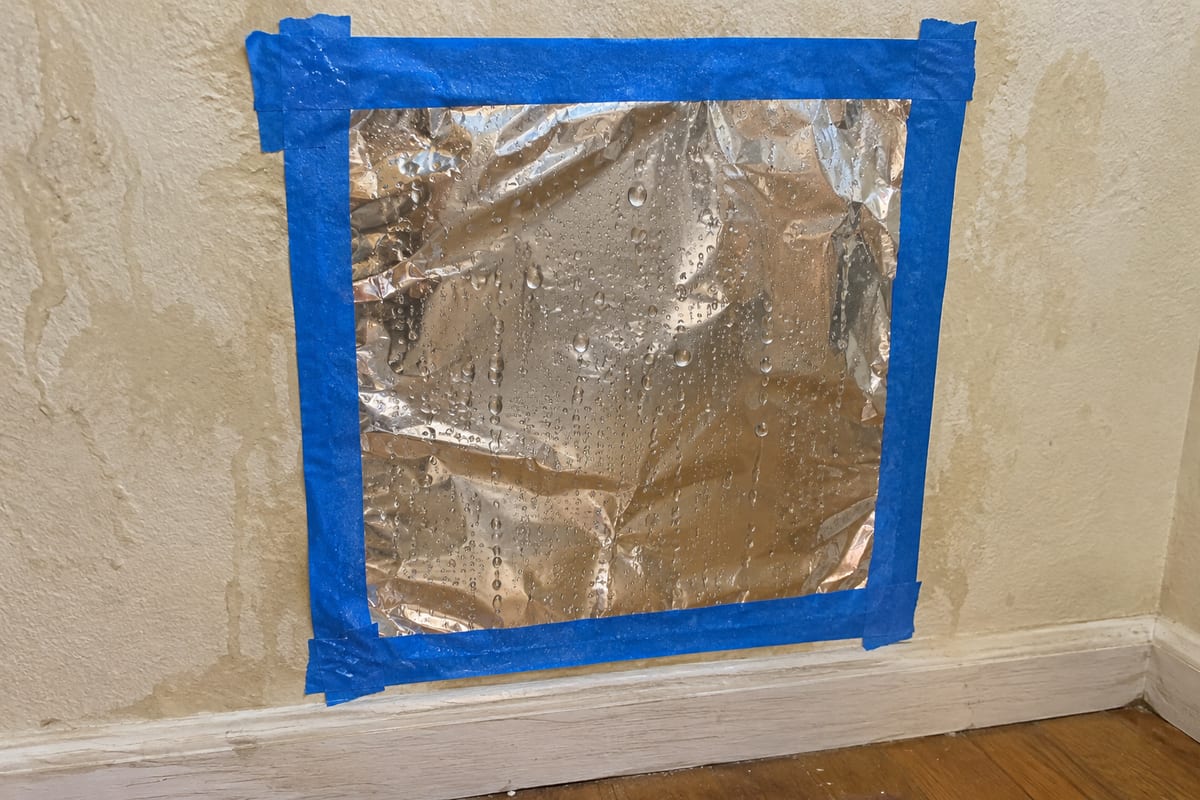
Treat the result as a hint, not a diagnosis. A dry result on a dry week doesn’t rule out a leak that only appears in heavy rain. Other signs of a leak: a wet patch that grows or stays in one shape regardless of the weather indoors, tide-mark stains, bubbling paint low on the wall, or dampness under a bathroom or next to a pipe run.
What doesn’t work (and why)
- Wiping and repainting. Paint over damp, moldy patches peels. The EPA says to clean and dry surfaces before painting, and not to paint or caulk over mold.
- Opening windows in summer. Humid outdoor air can add moisture instead of removing it. Airing out works mainly in cold, dry weather.
- Closing off the cold room. Shutting the door on a chilly spare room makes its walls colder and wetter.
- Moisture absorber tubs alone. Small desiccant tubs hold a limited amount of water. They can’t keep up with the gallons a household adds every day.
- Turning the heat way down to save money. Colder walls reach the dew point sooner. The EPA links setback thermostats to mold growth.
- Mold testing. The CDC does not recommend it. If you see mold, clean it and fix the moisture.
When to call a professional
Get help from an insulation contractor, plumber, roofer, or building inspector when:
- Walls stay wet even with humidity held at 30–50%.
- The foil test or stains point to water coming through the wall.
- The same corner gets wet or moldy every winter, which suggests missing insulation or air leaks.
- Mold covers more than about 10 sq ft (about 1 m²). The EPA advises using a contractor experienced with mold for larger areas.
- Someone in the home has asthma or mold allergy. The CDC notes they may have severe reactions.
For a small patch of mold under 10 sq ft, the EPA says you can usually clean it yourself: scrub hard surfaces with detergent and water and dry them completely. Damp bathrooms also draw moisture-loving pests such as silverfish in the bathroom which thrive in the same damp conditions.
Closing checklist
- Hygrometer in the problem room, humidity at 30–50%
- Bathroom and kitchen fans vent outdoors and run during use
- Dryer vented outside; no indoor laundry drying in winter
- Furniture a few inches off outside walls, closet doors open
- Rooms heated evenly, no deep setbacks in cold rooms
- Dehumidifier sized for the space, doors closed while it runs
- Foil test done on any wall that stays wet
- Insulation checked at corners and the ceiling edge
Frequently asked questions
What causes condensation on walls?
Warm indoor air carries water vapor. When that air touches a wall that is colder than its dew point, the vapor turns into liquid water on the surface. Too much moisture indoors, cold spots from missing insulation, and poor air movement are the usual causes, often together.
Is condensation on walls bad?
A little fog on a bathroom wall after a shower that dries within an hour is normal. Walls that stay wet for days are a problem, because damp surfaces let mold grow, paint peel, and wood rot. The EPA notes that mold is often found in cold corners behind furniture where condensation forms.
Why is there condensation on my walls but not my windows?
Modern double-glazed windows stay warmer than older single panes, so they may no longer be the coldest surface in the room. A wall with missing insulation, an outside corner, or a closet on an exterior wall can then become the first place water appears. EPA building guidance notes that better windows let indoor moisture climb higher without visible window condensation.
How do I stop condensation on walls in my bedroom?
Keep the bedroom heated rather than letting it get very cold at night, pull furniture a few inches off outside walls, and leave the door open so air circulates. Keep indoor humidity between 30% and 50%, and dry laundry outside the bedroom. If the same corner gets wet every winter, have the insulation checked.
Why do I get condensation on walls in summer?
In summer the cold surface is usually the one you cooled. Air conditioning blowing directly on a wall, or a basement wall in contact with cool soil, can drop below the dew point of humid indoor air. Reduce humidity with the AC or a dehumidifier and keep windows closed on muggy days.
Will a dehumidifier stop condensation on walls?
It often helps a lot when the air is too moist, especially in basements and closed rooms. It won't fully fix a wall that is unusually cold because of missing insulation or air leaks. Run it with doors and windows closed, as ENERGY STAR recommends.
Sources
- US EPA — Appendix C: Moisture, Mold and Mildew (Building Air Quality guide)
- US EPA — A Brief Guide to Mold, Moisture and Your Home
- US EPA — Mold Course Chapter 2
- Montana State University Extension — Controlling Condensation in the Home
- National Weather Service — Dew Point vs. Relative Humidity
- ENERGY STAR — Dehumidifiers
- CDC — About Mold and Your Health
- US EPA — Mold Cleanup in Your Home