How to Get Rid of Clothes Moths (and Stop the Larvae for Good)
Contents
- How to get rid of clothes moths: what to do today
- Confirm it’s clothes moths: 1/4-inch golden moths that avoid light
- Find the source: the larvae are where you rarely look
- Kill larvae and eggs: freeze at 0°F for a week, or wash at 120°F
- Pheromone traps: a scorecard, not a cure
- What doesn’t work (and why)
- When to call a professional
- Store woolens so clothes moths can’t come back
To get rid of clothes moths, you have to find and kill the larvae, not the flying moths: locate every infested wool or animal-fiber item, then wash it hot, dry-clean it, or freeze it, vacuum the closet and carpet edges, and store clean items sealed.
- What works: finding the source, then heat (120°F / 49°C wash or dryer), dry cleaning, or freezing at 0°F (-18°C) for a week, plus thorough vacuuming.
- How long: a weekend to treat items, then several months of checking traps, because larvae can take a month to two years to develop.
- When to call a pro: the infestation keeps coming back, it’s in stuffed furniture, mattresses, or piano felts, or it’s spread through the house.
How to get rid of clothes moths: what to do today
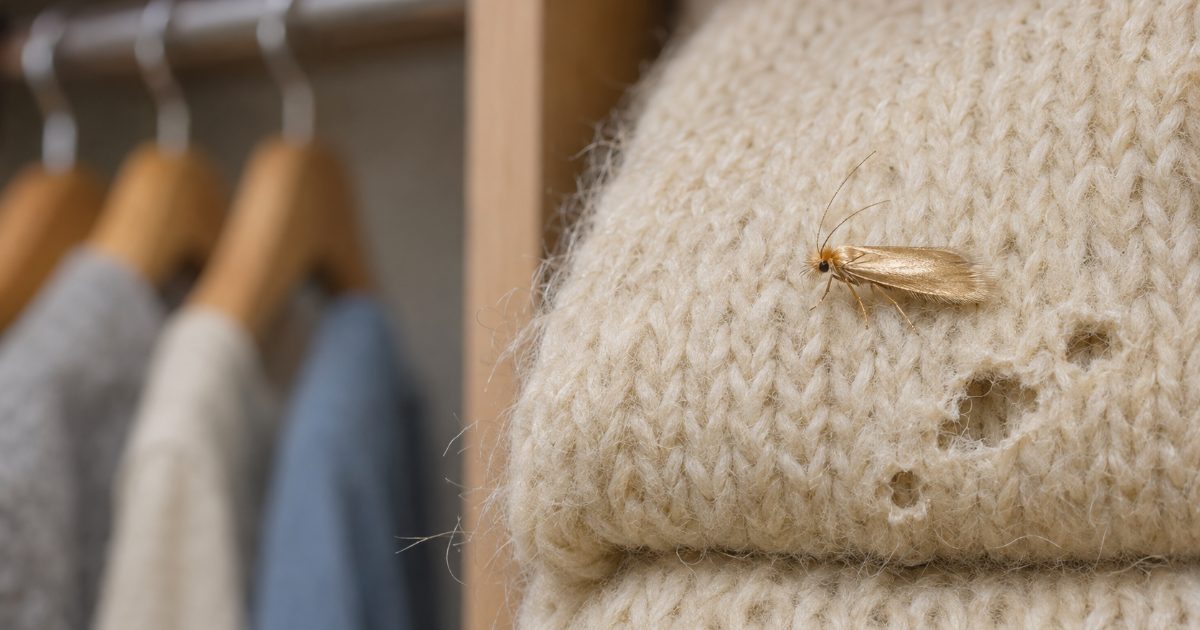
The moths you see fluttering in the closet are not eating anything. Adult clothes moths don’t feed at all. The damage comes from their larvae, small creamy-white caterpillars that chew on wool, fur, silk, feathers, felt, and leather, according to the University of Kentucky’s extension entomologists.
So the job is simple to describe and tedious to do: find every item the larvae are living in, kill them there, and remove what they feed on.
- Empty the closet or drawer that has moths. Take everything out, including shoes, bags, hats, and boxes on the top shelf.
- Sort by fiber. Wool, cashmere, alpaca, mohair, silk, fur, felt, feathers, and leather go in the "at risk" pile. Pure cotton and synthetics are low risk unless they're blended with wool or stained.
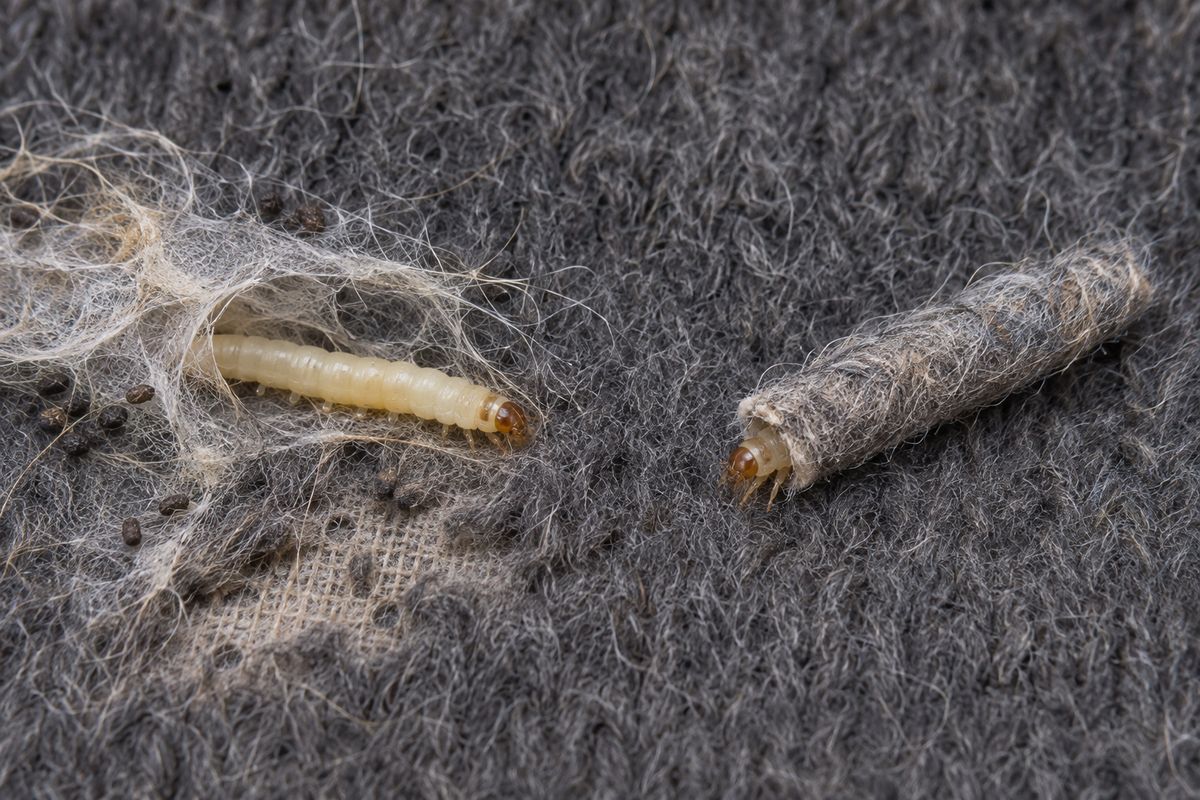
- Inspect the at-risk pile closely. Look under collars, inside cuffs, along seams and folds, and in pockets. You're looking for holes, thin "grazed" spots, silky webbing, tiny pellets, or small tubes stuck to the fabric.
- Bag anything infested right away. Seal it in a plastic bag so larvae and eggs don't drop off while you carry it through the house.
- Kill the larvae and eggs. Hot-wash, tumble dry hot, dry-clean, or freeze each item (methods and settings below).
- Vacuum the empty space. Floor, corners, shelves, baseboards, and the carpet edge under the closet door. Empty the vacuum or remove the bag outdoors right away.
- Put out pheromone traps. They won't solve the problem, but they tell you if moths are still emerging.
- Return only clean items, and store off-season wool sealed.
Confirm it’s clothes moths: 1/4-inch golden moths that avoid light
Before you start washing everything, make sure you have the right insect. Two clothes moths are common in North American homes, and both are small.
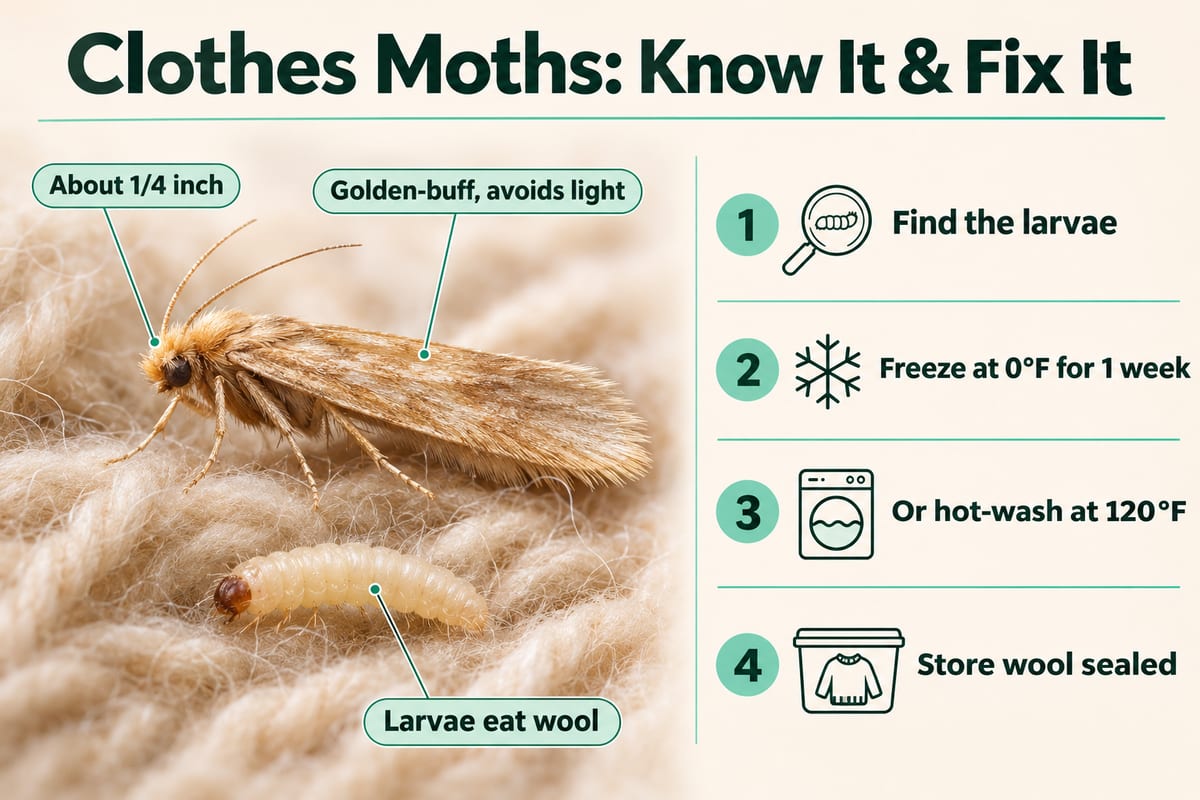
At rest, clothes moths are only about 1/4 inch (6 mm) long, with a wingspan around 1/2 inch (13 mm), according to UC IPM. They flutter weakly, aren’t drawn to lights, and tend to stay in closets, basements, and attics.
| Webbing clothes moth | Casemaking clothes moth | |
|---|---|---|
| Scientific name | Tineola bisselliella | Tinea pellionella |
| Adult color | Even golden-buff, no spots, tuft of reddish hairs on the head | More brownish, with faint dark specks on the wings |
| Larva | Creamy white, up to 1/2 inch (13 mm), spins silk tubes and patches of webbing on the fabric | Lives inside a portable silk case covered in fibers from what it eats; full-grown case about 3/8 inch (10 mm) |
| Signs on fabric | Webbing, tiny fecal pellets, threadbare patches | Little to no webbing; cases on fabric, shelf crevices, or where walls meet the ceiling |
| Pheromone trap | Needs a webbing clothes moth lure | Needs a casemaking clothes moth lure |
Source: University of Kentucky ENTFACT-609; UC IPM Pest Notes: Clothes Moths.
Small moths flying around a bright kitchen are probably pantry moths. Those are roughly twice as long at rest, fly in a straight line, and come from flour, cereal, nuts, dried fruit, or pet food.
Holes but no moths and no webbing? You may have carpet beetles instead. Their larvae eat the same fibers, and the damage is easy to confuse. Look for brown, bristly shed skins, which point to beetles. Our guide to identifying and getting rid of carpet beetles covers how to tell them apart. Many homes have both, and the cleanup below works on both.
Find the source: the larvae are where you rarely look
Most failed clothes moth treatments have the same cause: one infested item was missed, and it reseeded the closet. A female lays about 40 to 50 eggs, so a single forgotten scarf can restart the problem.
Larvae prefer dark, undisturbed spots and items soiled with food, sweat, or body oils. Check these places:
- Closet shelves and bins: wool hats, scarves, gloves, felt items, and anything stored for a season or longer.
- Rugs and wall-to-wall carpet: edges, undersides, and the areas under heavy furniture. The University of Kentucky suggests using needle-nose pliers to lift wall-to-wall carpet off the tack strip along the baseboard and look underneath.
- Upholstered furniture: underneath and in crevices, especially if it contains wool, horsehair, or feathers.
- Floor vents, ducts, and baseboards: larvae can live on shed pet hair and lint that collects there.
- Less obvious items: piano felts, natural-bristle brushes, wool-felt hats, down pillows and comforters, taxidermy, and toys or decorations made with wool or feathers.
- The attic and chimney: old bird or rodent nests and dead animals can support clothes moths and send them into living space.
Kill larvae and eggs: freeze at 0°F for a week, or wash at 120°F
Once you’ve found infested items, you have four reliable ways to kill every stage, from egg to adult. Pick by fabric, not by convenience. Check the care label first, since some wool shrinks or felts in heat.
| Method | Setting that kills moths | Best for |
|---|---|---|
| Hot wash | 20–30 minutes in water at least 120°F (49°C) | Washable wool blends, blankets, cotton-wool mixes |
| Clothes dryer | A hot dryer cycle | Items whose label allows tumble drying |
| Dry cleaning | Standard dry cleaning | Suits, coats, wool that can't take hot water |
| Freezing | 0°F (-18°C) for at least 1 week, or -20°F (-29°C) for 72 hours | Delicate knits, vintage items, hats, small rugs, things you can't wash |
Source: University of Kentucky ENTFACT-609 (freezing, dryer, dry cleaning); UC IPM Pest Notes: Clothes Moths (wash temperature).
How to freeze properly:
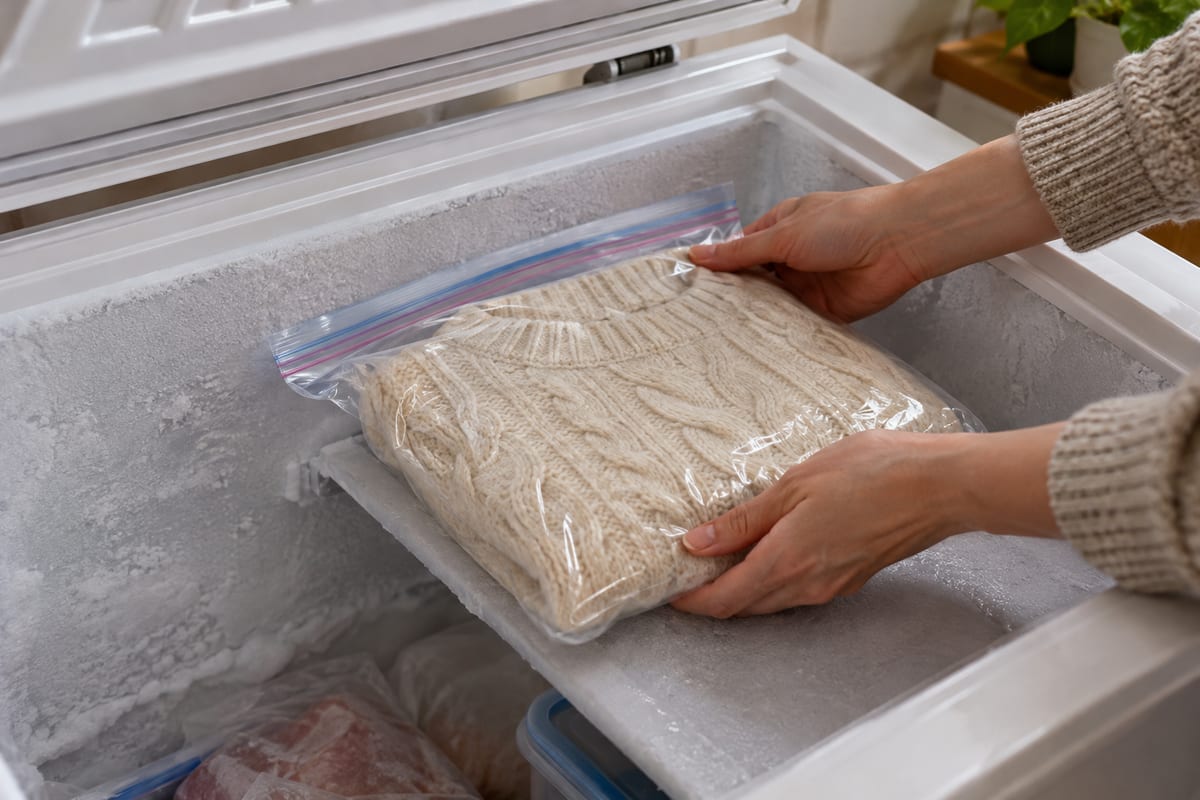
- Seal the item in a plastic bag and squeeze out extra air. This keeps frost off the fabric.
- Use a chest or upright freezer that holds 0°F (-18°C). Many home freezers run near this, but check with a freezer thermometer if you are unsure.
- Leave it for a full week. If your freezer reaches -20°F (-29°C), 72 hours is enough.
- Let the bag sit at room temperature for about 24 hours before opening it, so condensation forms on the bag and not on your sweater.
UC IPM also lists oven heating, at 120°F (49°C) or higher for at least 30 minutes. That carries real risk of scorching or damage, so reserve it for small, sturdy items and test first.
Brushing helps too. Taking woolens outside, brushing them hard along seams, folds, and pockets, and letting them sit in the sun destroys eggs and exposes larvae, which dislike bright light.
Clothes moths in carpet and rugs
For rugs, vacuum both sides thoroughly, paying attention to edges and the area under furniture. Small wool rugs can go to a professional rug cleaner or be frozen in sections if they fit.
If you choose an insecticide for carpet edges, use one whose label lists clothes moths or fabric pests, and treat only carpet edges, floor-wall joints, under furniture, and closet floors. Follow the label: the label is the law. Never spray clothing or bedding, keep children and pets out until it’s dry, and don’t use outdoor products indoors. Extension sources describe sprays as a supplement only, because larvae are usually inside materials where sprays don’t reach.
Pheromone traps: a scorecard, not a cure
Pheromone traps are small sticky cards with a lure that imitates the female moth’s scent. They catch males, which makes them excellent for one thing: telling you whether moths are still present and where they’re coming from.
- Buy the right lure. Webbing and casemaking clothes moths respond to different pheromones. A trap for one may not catch the other, so match the lure to the moth you identified.
- Use several traps. The University of Kentucky suggests spreading traps out in a grid; the one catching the most moths is usually closest to the infested item.
- Read them over time. A few catches right after cleanup can be moths that were already flying. Steady new catches weeks later mean a source is still out there.
- Don’t rely on them for control. Trapped males can’t mate, but females still lay eggs. UC IPM says to combine traps with laundering or dry cleaning.
- Place them where wool lives. Closets, shelves, and storage areas are the spots extension guides recommend.
What doesn’t work (and why)
Mothballs tossed into an open closet or drawer. Mothballs contain naphthalene or paradichlorobenzene, both pesticides. The National Pesticide Information Center (NPIC) says the label directs you to use them in a tightly closed container, where the vapor builds up enough to kill moths. In an open closet, the vapor escapes into your home instead. UC IPM notes that in loose storage they mainly repel adults while larvae keep feeding. Using them any other way than the label says is illegal.
Breathing that “mothball smell.” NPIC puts it plainly: when you smell mothballs, you are inhaling the insecticide. Naphthalene vapor has caused headaches, nausea, dizziness, and vomiting, and NPIC reports that clothing stored with mothballs and not washed afterward has caused anemia in infants who wore it. One mothball can seriously harm a small child who swallows it. If that happens, call Poison Control at 800-222-1222.
Cedar closets, cedar blocks, and lavender sachets. The University of Kentucky says cedar closets and chests are seldom effective because the seal can’t hold enough cedar oil vapor. UC IPM adds that cedar oil kills only small larvae and fades after a few years, and that herbal oils have unclear effectiveness. Use them for scent, not protection.
Swatting the moths you see. Killing adults feels productive, but they’re the end of the life cycle. The larvae keep eating either way.
Spraying your clothes. The University of Kentucky advises against treating infested clothing or bedding with insecticides. Washing, dry cleaning, and freezing kill the larvae without leaving residue on fabric you wear.
Moving infested items to another closet. That just relocates the problem. Treat first, then move.
When to call a professional
Most clothes moth problems are handled at home. Call a licensed pest control company or a specialist when:
- Moths keep showing up in traps for months after a thorough cleanup and you can’t find the source.
- The infestation is inside stuffed furniture, mattresses, or pillows. Spraying the outside won’t reach larvae inside, and UC IPM notes these may need fumigation.
- Several rooms, wall-to-wall carpet, or valuable rugs are involved.
- Piano felts are damaged. A piano technician can advise on repair or replacement.
- You suspect a bird or animal nest in the attic, chimney, or wall.
For heirlooms and furs, a professional cleaner or a fur storage service is often safer than home treatment.
Store woolens so clothes moths can’t come back
Clean storage is the real long-term fix. Larvae are drawn to fabric with sweat, food, or body oils on it, and they can’t get into a container that’s actually sealed.
- Clean before you store. Wash or dry-clean every wool item before putting it away for the season. That kills any eggs and removes the odors that attract moths.
- Seal it. Use zip-top storage bags or plastic bins with tight lids. Cardboard boxes and open shelves are easy targets.
- Keep the closet clean and a little disturbed. Vacuum the floor and shelves regularly, and rotate stored items once or twice a season. Larvae prefer places nothing moves.
- Watch for damp, stale closets. Musty, closed-up spaces are where stored textiles tend to be forgotten. If a closet smells damp, our guide to finding the cause of a musty smell in the house can help.
- Keep an eye out for other pests. If you spot slender, silvery insects in damp rooms while you clean, see our guide to silverfish in the bathroom.
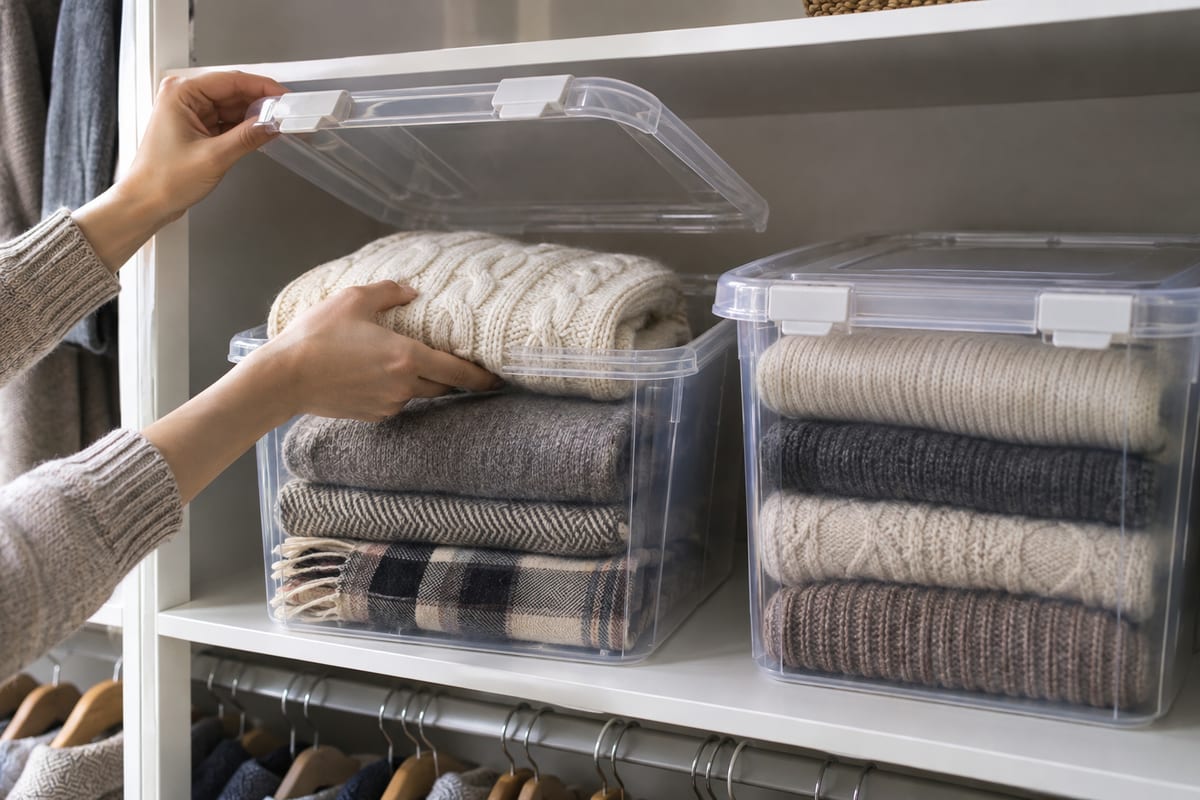
Clothes moth checklist
- Every wool, silk, fur, feather, and felt item inspected, including shelves and bins
- Infested items bagged, then hot-washed, dried hot, dry-cleaned, or frozen at 0°F (-18°C) for a week
- Closet floor, shelves, baseboards, carpet edges, and vents vacuumed; vacuum emptied outside
- Pheromone traps with the right lure placed and checked every week or two
- Off-season wool cleaned and stored in sealed bags or tight bins
- No mothballs in open closets; any used only in a sealed container, per the label
Frequently asked questions
How long does it take to get rid of clothes moths?
Treating the infested items takes a few days, but the full job takes longer. Clothes moth larvae can take anywhere from about a month to two years to develop, depending on temperature and food, so eggs or larvae hidden in an item you missed can produce new moths months later. Keep pheromone traps out and check them for several months after the cleanup.
What is the fastest way to kill clothes moth larvae?
Heat is the fastest. Hot-washing washable items for 20 to 30 minutes in water of at least 120°F (49°C), a hot dryer cycle, or dry cleaning kills eggs and larvae in one go. For wool that can't take heat, freezing at 0°F (-18°C) for at least a week works but is slower.
How do I get rid of clothes moths without mothballs?
Most infestations are cleared without mothballs at all. Find and treat every infested item by washing, dry cleaning, or freezing, vacuum closets and carpet edges thoroughly, and store clean wool in sealed plastic bags or tight bins. Pheromone traps then show you whether moths are still around.
Why do I keep seeing clothes moths when I can't find the source?
The source is usually something you rarely touch: a wool hat at the back of a shelf, a stored rug, felt in a piano, a bin of old sweaters, or a bird nest in the attic. Larvae also feed on pet hair and lint inside floor vents and under baseboards. Lift carpet edges, check upholstered furniture underneath, and use pheromone traps in a grid; the trap catching the most moths is usually closest to the source.
Do clothes moths eat cotton or polyester?
Rarely. Clothes moth larvae digest keratin, the protein in wool, fur, silk, feathers, felt, and leather. Cotton and synthetics get damaged mainly when blended with wool or heavily soiled with food stains or body oils.
Are the moths in my kitchen clothes moths?
Probably not. Clothes moths avoid light and stay in dark closets, basements, and attics, and they flutter weakly rather than flying across rooms. Moths in a lit kitchen or pantry are usually pantry moths coming from flour, cereal, nuts, or pet food, which need a different fix.
Sources
- University of Kentucky Entomology — ENTFACT-609: Clothes Moths
- UC IPM — Pest Notes: Clothes Moths (Pub. 7435)
- National Pesticide Information Center — Mothballs: Regulation and Proper Use
- National Pesticide Information Center — Health Effects of Mothballs
- National Pesticide Information Center — Naphthalene General Fact Sheet
- University of Kentucky Entomology — ENTFACT-609: Clothes Moths (web version)
- UC IPM — Pantry Pests
- U.S. EPA — Introduction to Pesticide Labels