How to Get Rid of Roaches in an Apartment That Shares Walls
Contents
- How to get rid of roaches in an apartment: what to do this week
- Why roaches in apartments come back: shared pipes and walls
- Where roaches hide in an apartment: kitchen first, then bathroom
- What tenants can do themselves (and what to leave to the building)
- Working with your landlord: building-wide IPM that works
- What doesn’t work (and why)
- When to call a professional (and who arranges it)
- Apartment roach checklist
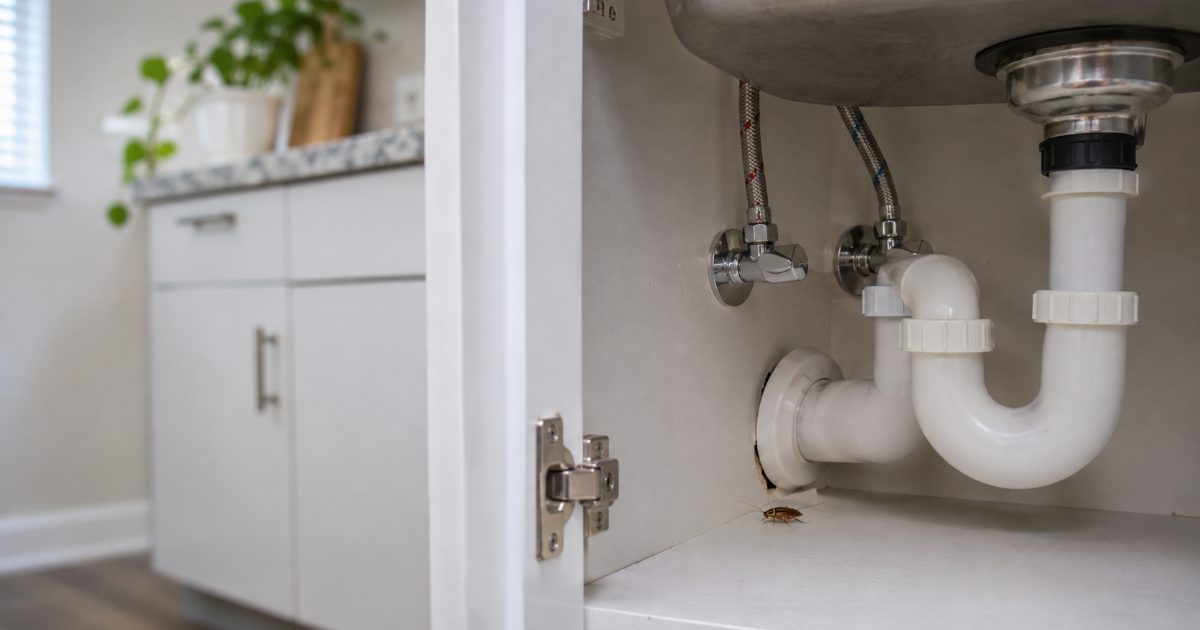
To get rid of roaches in an apartment, you need two things at once: bait and cleanup inside your own unit, and a building-wide treatment that also covers the units around you. Treat only your apartment and the roaches living in shared walls and plumbing will simply walk back in.
- What works: gel bait or bait stations in your kitchen and bathroom, a written report to management, and inspection of the units beside, above, and below you.
- How long: a single unit often improves in a few weeks; a whole building takes months of follow-up every one to two weeks.
- Call in the pros: right away in a rental. Pest control in multi-unit buildings normally runs through management and its contracted company.
How to get rid of roaches in an apartment: what to do this week
Roaches in apartments are almost always German cockroaches, the small tan species with two dark stripes behind the head. If you are not sure, compare yours with our German cockroach identification and baiting guide.
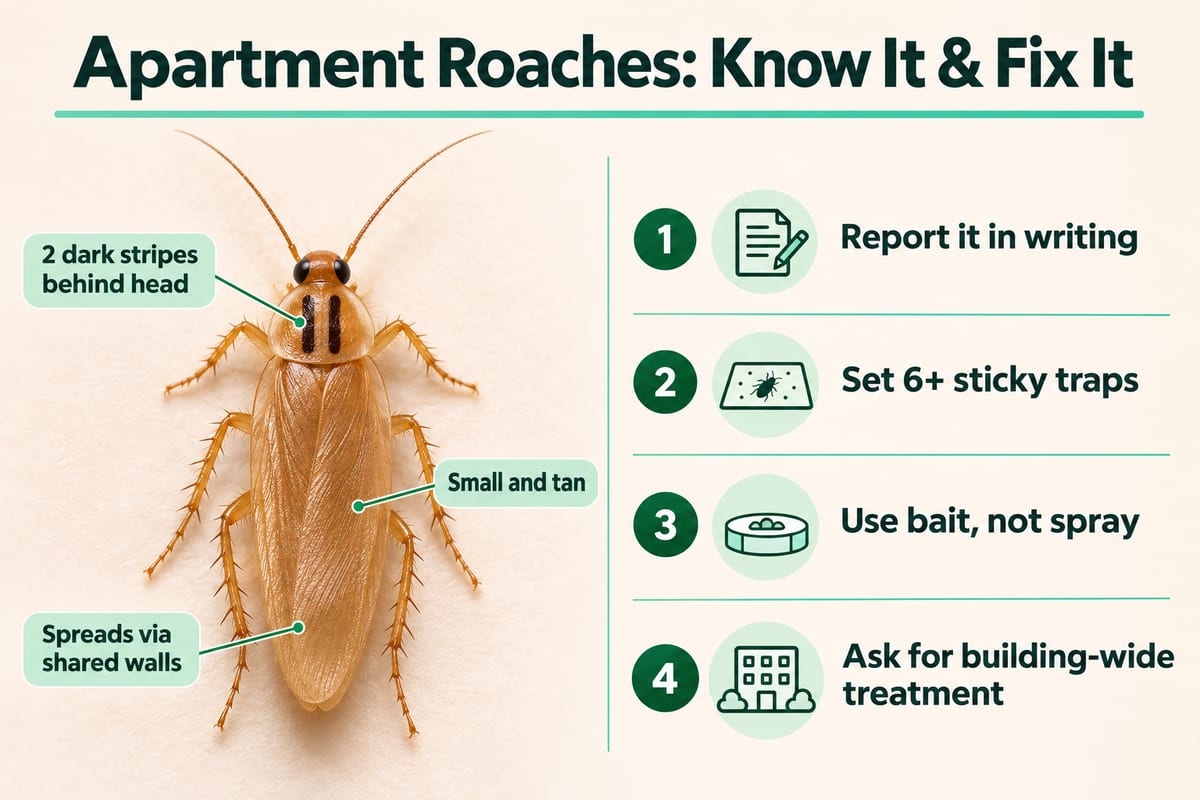
Start with these steps in order.
- Report it in writing today. Email or use the building's maintenance portal, describe where you saw roaches and how many, and keep a copy. The StopPests in Housing program, which works with HUD-assisted housing, tells property managers that residents should never be punished for reporting pests and that prompt reporting is critical.
- Put out sticky traps. Purdue Extension suggests at least six traps per home: in cabinets above and under the sink, beside the stove and refrigerator, and along bathroom walls. Date them. They show where roaches are coming from.
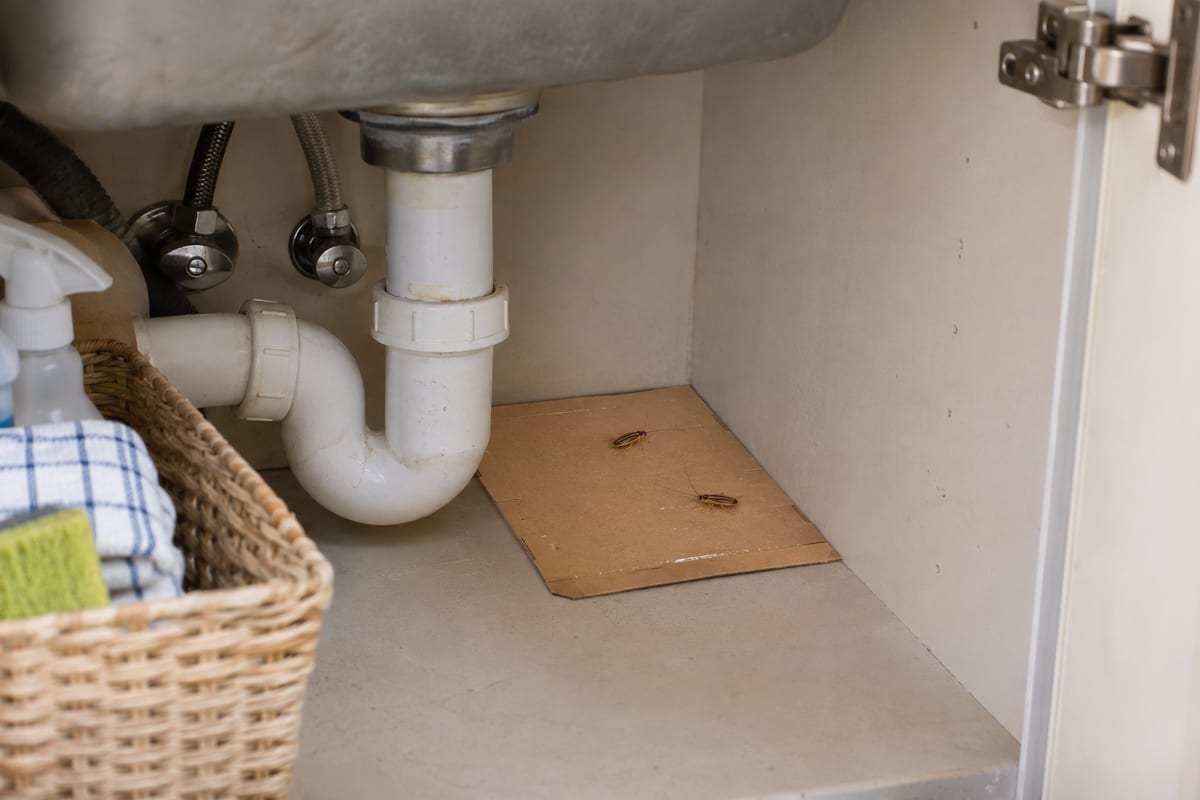
A sticky trap set flat in the back corner under the kitchen sink. Traps pushed against walls and corners catch the most, because roaches travel along edges. - Use bait, not spray. Containerized bait stations are the product the StopPests guide recommends residents buy themselves. Place them where traps catch roaches, out of reach of kids and pets. Follow the label, because the label is the law.
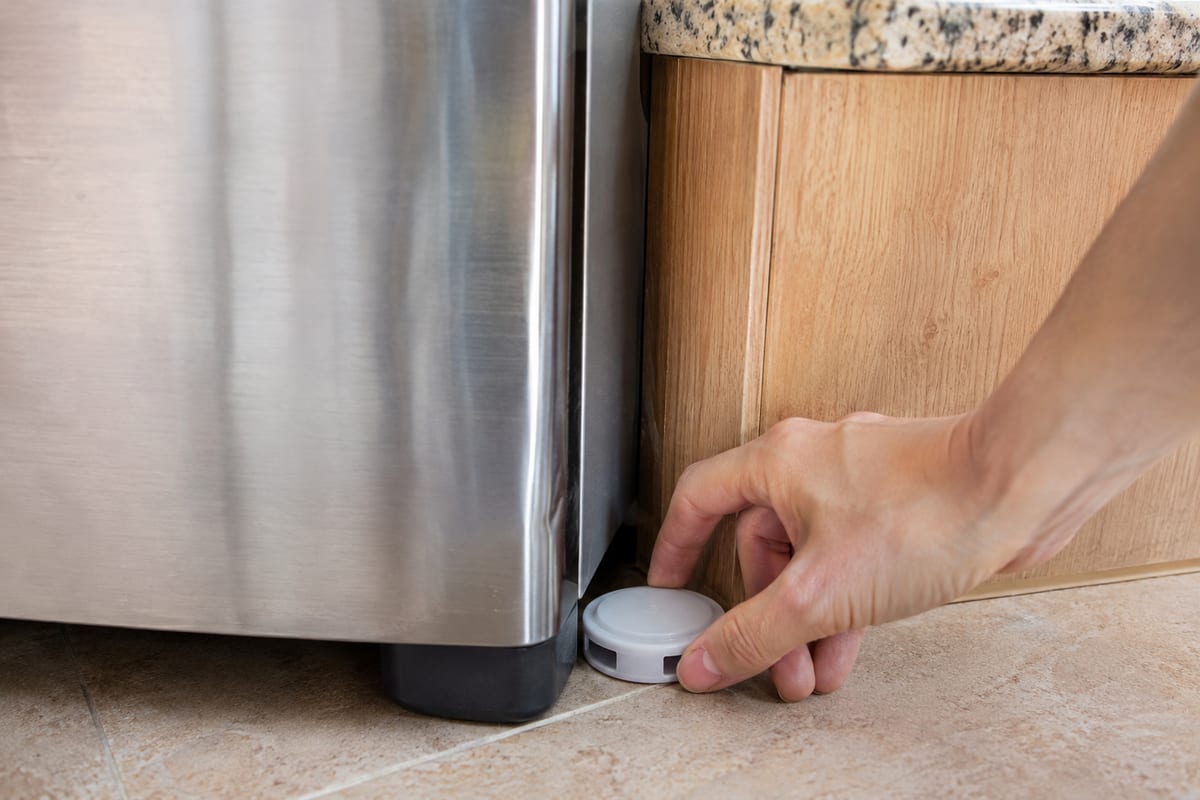
Tuck bait stations into the edges roaches already use, such as the gap beside the refrigerator, rather than in the open middle of the floor. - Cut off food and water at night. Wipe up spills daily, don't leave dishes or pet food out overnight, and bag kitchen trash and take it out daily.
- Remove hiding spots. Unpack and recycle cardboard. Clear clutter under the sink and on top of the refrigerator.
- Ask who else is affected. Ask management to inspect the apartments that share a wall, floor, or ceiling with yours.
Why roaches in apartments come back: shared pipes and walls
Apartments share more than walls. Kitchen and bathroom plumbing often runs straight up through every floor, and the gaps around those pipes connect your cabinets to your neighbors’.
Researchers at Rutgers mapped German cockroaches in a 188-unit high-rise during a building-wide program. At the start, 49% of apartments were infested. Infested units clustered next to each other across hallways, shared walls, and shared floors and ceilings, and the link was strongest vertically, along the plumbing stacks. Units that shared a wall often shared plumbing too.
That is why a perfectly clean tenant can still have roaches. The StopPests guide states it plainly: poor sanitation does not cause infestations, though it makes ongoing ones harder to control. Roaches arrive in grocery bags, cardboard boxes, furniture, and other belongings, then spread from unit to unit.
It also explains “reservoir units.” When one apartment in a stack refuses access or never gets treated, the units around it keep getting reinfested.
Where roaches hide in an apartment: kitchen first, then bathroom
In the same high-rise study, sticky traps by the stove and refrigerator caught the most roaches, about 35% and 36% of the total. Traps under the sink caught 17%, and bathroom traps 12%.
| Spot | Why roaches like it | What you can do |
|---|---|---|
| Behind and beside the refrigerator | Warmth from the motor, crumbs, dark gaps | Trap and bait along the sides; clean underneath when you can |
| Around the stove | Grease, food bits, warm gaps | Wipe grease daily; bait cabinet edges nearby |
| Under the kitchen sink | Water, pipe gaps to other units | Report pipe gaps and leaks; bait the back corners |
| Bathroom vanity and toilet | Moisture, plumbing access | Fix drips; trap along the wall |
| Cardboard and clutter | Tight, dark harborage | Unpack and recycle boxes quickly |
Source: Zha et al. 2019, Journal of Economic Entomology; Purdue Extension E-241-W.
The UF/IFAS Extension recommends not keeping cardboard boxes longer than 3 to 6 months. In an apartment with a roach problem, get them out sooner.
What tenants can do themselves (and what to leave to the building)
Purdue Extension splits the job three ways. Good control, it says, cannot be achieved without cooperation among residents, management staff, and the pest control company.
| Who | Their part of the job |
|---|---|
| You (the tenant) | Keep the unit clean, wash or soak dishes, cover garbage and tie bags, reduce clutter, report roaches and leaks, allow access for treatment |
| Management and maintenance | Fix leaks in units and common areas, seal cracks where cabinets meet walls and floors, seal around plumbing and electrical openings |
| Pest control company | Inspect thoroughly, place bait, use HEPA vacuums on heavy infestations, report conditions that need fixing |
Source: Purdue Extension E-241-W, Bennett and Wang.
Things you can usually do without asking anyone:
- Place sticky traps and store-bought bait stations.
- Store cereal, crackers, sugar, bread, and other dry food in sealed containers or the refrigerator.
- Run the dishwasher or wash dishes before bed.
- Put pet food away overnight.
- Take kitchen trash to the building’s chute or dumpster every day.
Things to report rather than fix yourself:
- Gaps around pipes and electrical lines, especially under sinks.
- Leaky faucets and pipes.
- Holes in walls or loose cabinet backs.
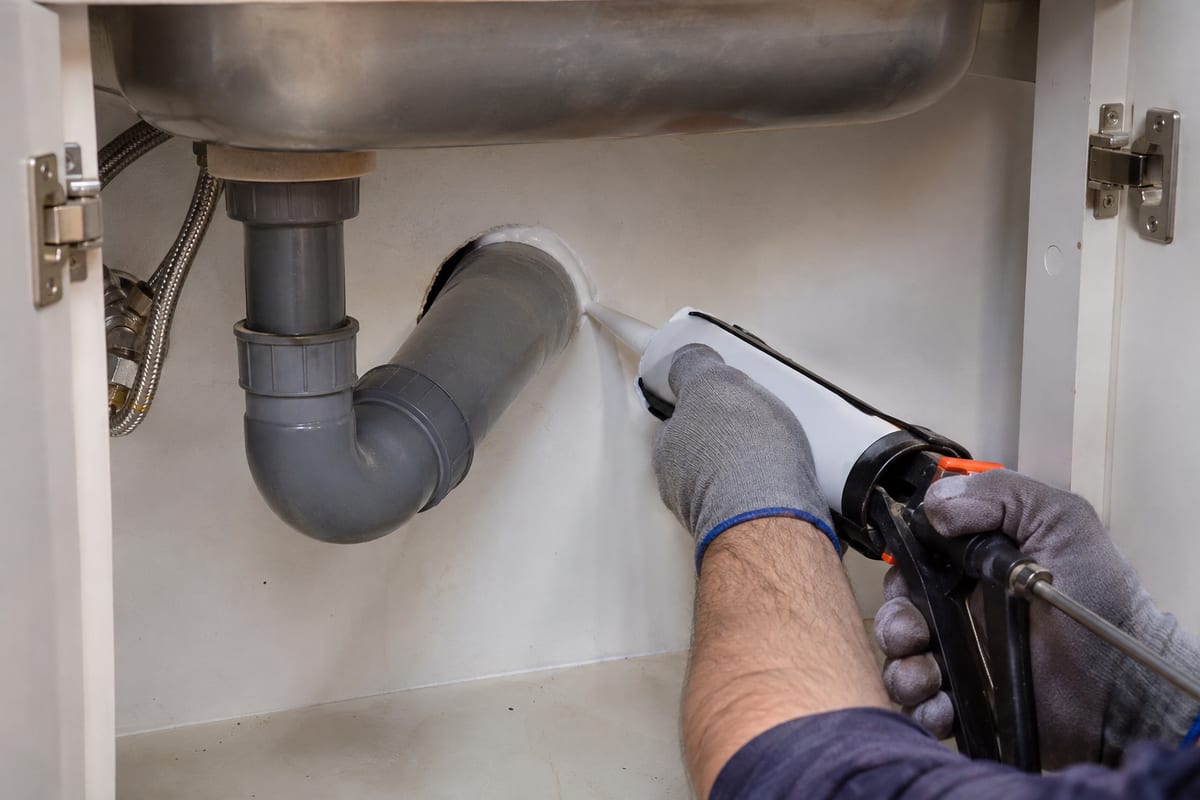
Sealing pipe gaps with caulk or foam may seem simple, but in a rental it is usually a maintenance job. Report it so the same fix gets done in the units around you.
For the baiting details (how much gel, where to place it, and why you rotate active ingredients), see the German cockroach treatment guide.
Working with your landlord: building-wide IPM that works
Integrated pest management (IPM) means inspecting, monitoring with traps, fixing the conditions roaches need, and using targeted bait instead of routine spraying. It is the approach HUD’s StopPests program trains property managers to use.
Here is what a good building program looks like, based on the StopPests property manager guide:
- Every unit gets inspected, not just the ones that complain. Many residents never report pests.
- Sticky traps in every unit, typically two in the kitchen and one under the bathroom sink or toilet.
- Infested units get follow-up visits every one to two weeks until traps catch zero roaches.
- Bait is the main tool. The guide calls baiting by far the most effective method and asks pest companies to rotate active ingredients at least every three months.
- Calendar sprays are dropped. Spraying on a schedule does not prevent or eliminate German cockroaches.
The results can be large. In a 258-unit New Jersey complex, a community-wide IPM program eliminated 85% of the original cockroach infestations within 7 months. In the 188-unit high-rise, infestation fell from 49% of apartments to 24% at 6 months and 12% at 12 months.
If your building’s service is “spray the baseboards once a month,” it is fair to ask management whether they use an IPM approach and whether units next to yours are being inspected.
Tenant rights around pests differ by state, city, and lease. In general, landlords are expected to keep rentals fit to live in, and written records help if a problem drags on. If nothing happens after reasonable follow-up, your local housing or health department can tell you what applies where you live.
What doesn’t work (and why)
| Myth | What the research says |
|---|---|
| A bug bomb will clear the apartment | NC State researchers tested four commercial foggers in five apartment complexes and found them ineffective against German cockroaches. The spray settles on open surfaces and leaves residue where you eat, not in the cracks where roaches hide. |
| Spraying my unit will drive them away for good | Over-the-counter sprays and foggers can repel roaches into deeper hiding and into surrounding apartments (StopPests). They come back once the spray wears off. |
| Spray plus bait works better | Sprays and scented oils can contaminate bait so roaches avoid it. Baiting can take weeks; avoid aerosol sprays during that time. |
| Home remedies are safer | The StopPests guide notes they have not been tested for efficacy or risk. Homemade dusts spread in open areas leave residue where children play. |
| Roaches mean I'm dirty | Poor sanitation does not cause infestations. It does make them harder to end, so cleanup still matters. |
Sources: NC State Extension (2019); StopPests in Housing, IPM for German Cockroaches.
Sprays also tend to fail because German cockroach populations build resistance quickly, as UF/IFAS Extension points out. Bait gets eaten and carried back to the hiding spots, which is why it works where sprays don’t.
When to call a professional (and who arranges it)
In an apartment, the professional is usually already arranged: management contracts a pest company. Push for a visit when:
- You see roaches out in the open on a regular basis.
- Traps fill up within a few days.
- You have used bait for two to three weeks with no drop in trap counts.
- Neighbors report roaches too.
- Someone in your household has asthma.
Ask the company to inspect the units next to, above, and below yours. A one-off treatment of a single unit in an infested stack is likely to fail.
If you own your condo or rent a single-family home, the same logic applies to your HOA or landlord for shared walls and common areas. Rodents spread through shared walls in a similar way; our guide to getting mice out of walls covers that side.
Roach allergens and asthma
The EPA notes that indoor pests such as cockroaches can trigger asthma and allergy symptoms. The StopPests guide adds that German cockroaches can carry bacteria that cause food poisoning.
Roach droppings and body parts can trigger asthma, according to the EPA, so removing dead roaches and droppings helps lower allergen levels. A vacuum with a HEPA filter is the tool professionals use for this. If someone in your home has asthma, tell management, and keep that person out of the room while you clean.
Apartment roach checklist
- Reported in writing, with dates and rooms
- At least six sticky traps placed and dated
- Bait stations in kitchen and bathroom, away from kids and pets
- No sprays or foggers while bait is out
- Dishes, pet food, and trash cleared every night
- Cardboard and clutter removed
- Pipe gaps and leaks reported to maintenance
- Adjacent units inspected
- Follow-up every one to two weeks until traps catch zero
Frequently asked questions
Can you get rid of roaches in an apartment if your neighbors have them?
You can clear your own unit, but roaches will keep coming back through shared plumbing and walls unless the infested units next to you are treated too. Building-wide programs that inspect and bait every unit have cut infestation rates sharply in published studies. Report the problem to management and ask them to inspect the units around yours.
What causes roaches in apartments?
German cockroaches arrive in grocery bags, cardboard boxes, furniture, and other belongings, then spread between units along pipes and wall gaps. Poor sanitation does not cause an infestation by itself, but crumbs, dirty dishes, and clutter make an existing one much harder to get rid of.
Should I use a bug bomb in my apartment?
No. A North Carolina State University study tested four over-the-counter foggers in five apartment complexes and found them ineffective against German cockroaches. Sprays and foggers can also push roaches deeper into walls and into neighboring units, and they contaminate baits a professional may place.
Is my landlord responsible for roaches?
In most places, landlords are expected to keep rental units fit to live in, and pest control in multi-unit buildings is usually handled by management through a contracted pest company. The exact rules depend on your state, city, and lease. Report the problem in writing, keep copies, and check your local housing agency if nothing happens.
How long does it take to get rid of roaches in an apartment?
With bait in your unit and a professional following up every one to two weeks, a single unit often improves within a few weeks. A whole building takes months: in one community-wide program, 85% of the original infestations were gone at 7 months.
I just moved in and see roaches. What should I do?
Report it to management in writing right away, before you fully unpack, and note the date. Ask whether neighboring units have had treatment. Keep boxes off the floor, unpack cardboard quickly, and recycle it outside the unit.
Sources
- Purdue Extension E-241-W — A Practical Guide to Cockroach Control in Multi-Family Housing Units
- StopPests in Housing — IPM for German Cockroaches: A Guide for Property Managers
- Zha et al. 2019, Journal of Economic Entomology — Spatial Distribution of German Cockroaches in a High-Rise Apartment Building
- Zha et al. 2018, Journal of Economic Entomology — Community-Wide IPM for Reducing Cockroach Infestations
- NC State Extension — Bug Bombs Are Ineffective at Killing Roaches Indoors
- UF/IFAS Extension — Insight to Managing Cockroaches in a Multi-family Dwelling
- US EPA — Public Health Issues Caused by Pests
- US EPA — Asthma Triggers: Gain Control (Cockroaches and Pests)