How to Keep Mice Out of Your Car (and Off Your Wiring)
Contents
- How to keep mice out of your car: what to do right now
- Why mice pick your car: warmth, shelter, and food within 30 feet
- Signs of mice in your car: droppings, nests, and a musty smell from the vents
- Parked-car habits that keep mice away
- What doesn’t work (and why)
- Cleaning up mouse droppings in a car the CDC way
- When to call a professional
- Closing checklist
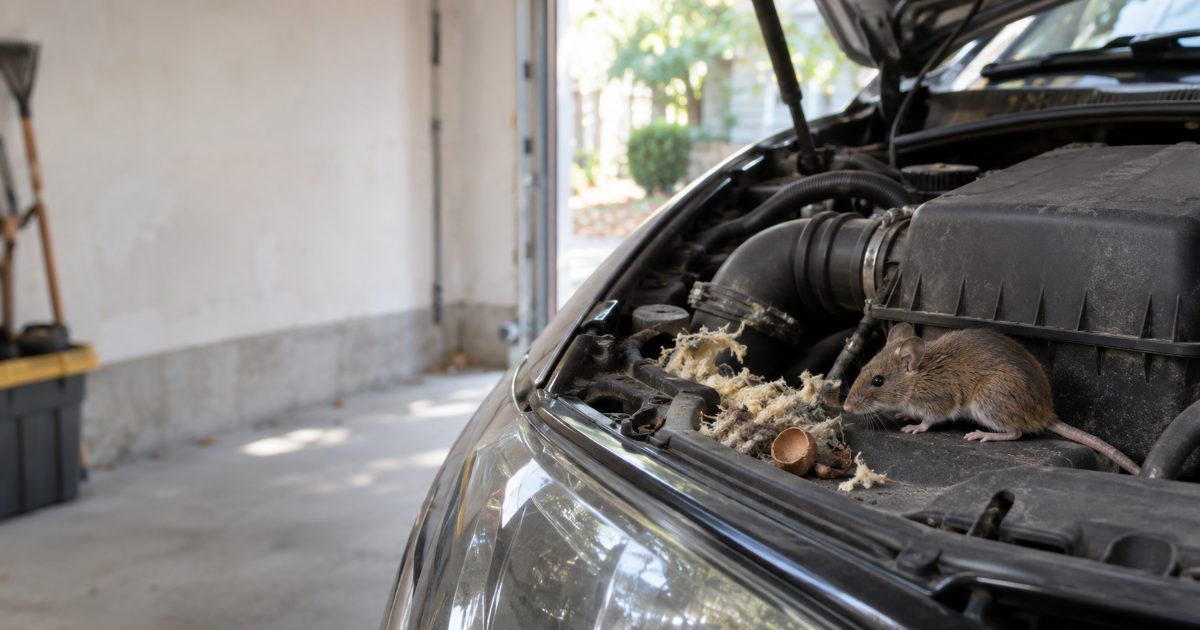
To keep mice out of your car, take away what draws them in (food, shelter, and an easy approach from tall grass or clutter), check the engine bay and cabin air filter often, and trap mice around the parking spot before they move in. House mice can squeeze through a gap about 1/4 inch (6 mm) wide, so you can’t seal a car the way you seal a house. Your best tools are habits and early detection.
What works: no food in the car, parking away from tall grass and clutter, snap traps around the car, and weekly checks under the hood.
How long: trapping usually clears a few mice in days; a car parked for months needs checks every week or two.
When to call a pro: chewed wires, warning lights, a burning smell, or a nest in the blower or ducts. That is a mechanic job first.
How to keep mice out of your car: what to do right now
If you just found droppings or a nest, work through these steps in order. Do not start the car and blast the fan first, since that can blow nest dust through the cabin.
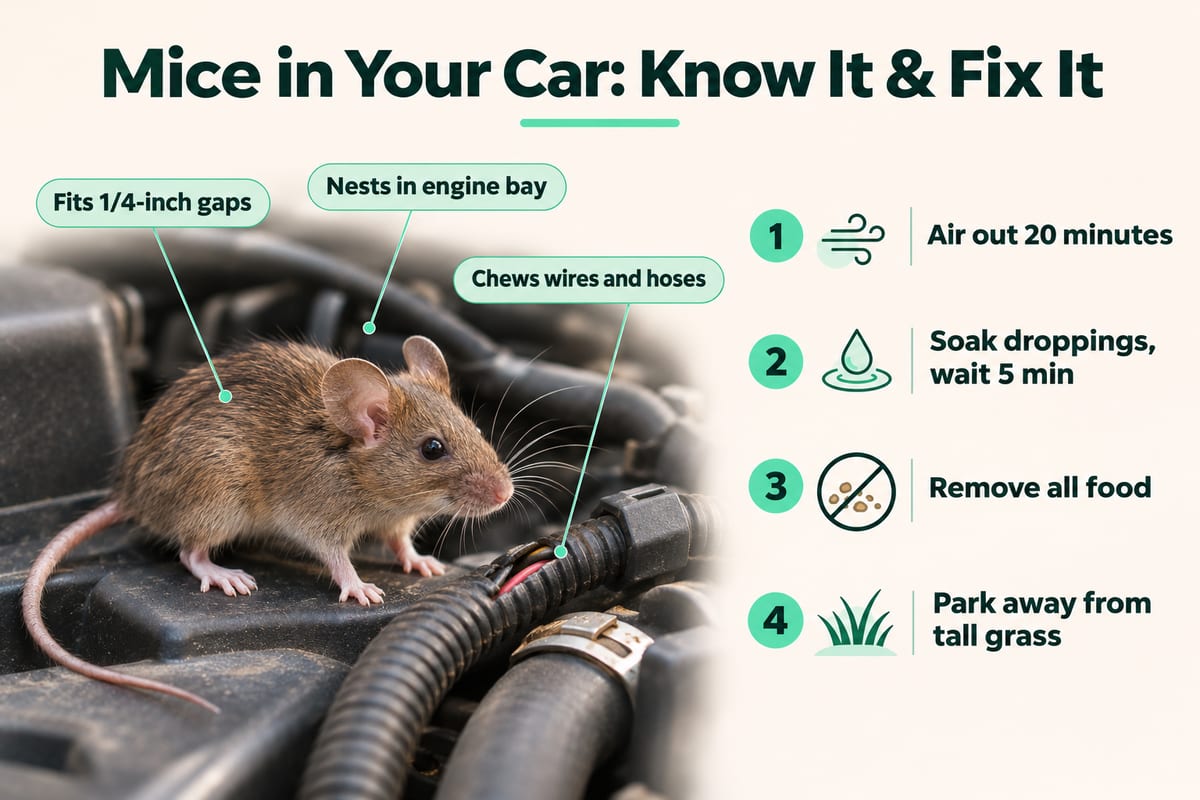
- Move the car outside if you can. Open the hood, all doors, and the trunk, and let the engine bay and cabin air out for 20 minutes before you start cleaning. This is the CDC's guidance for vehicles.
- Disconnect the battery. Public Health — Seattle & King County recommends removing the battery cables before cleaning the engine bay to reduce shock risk. Reconnect only when everything is dry.
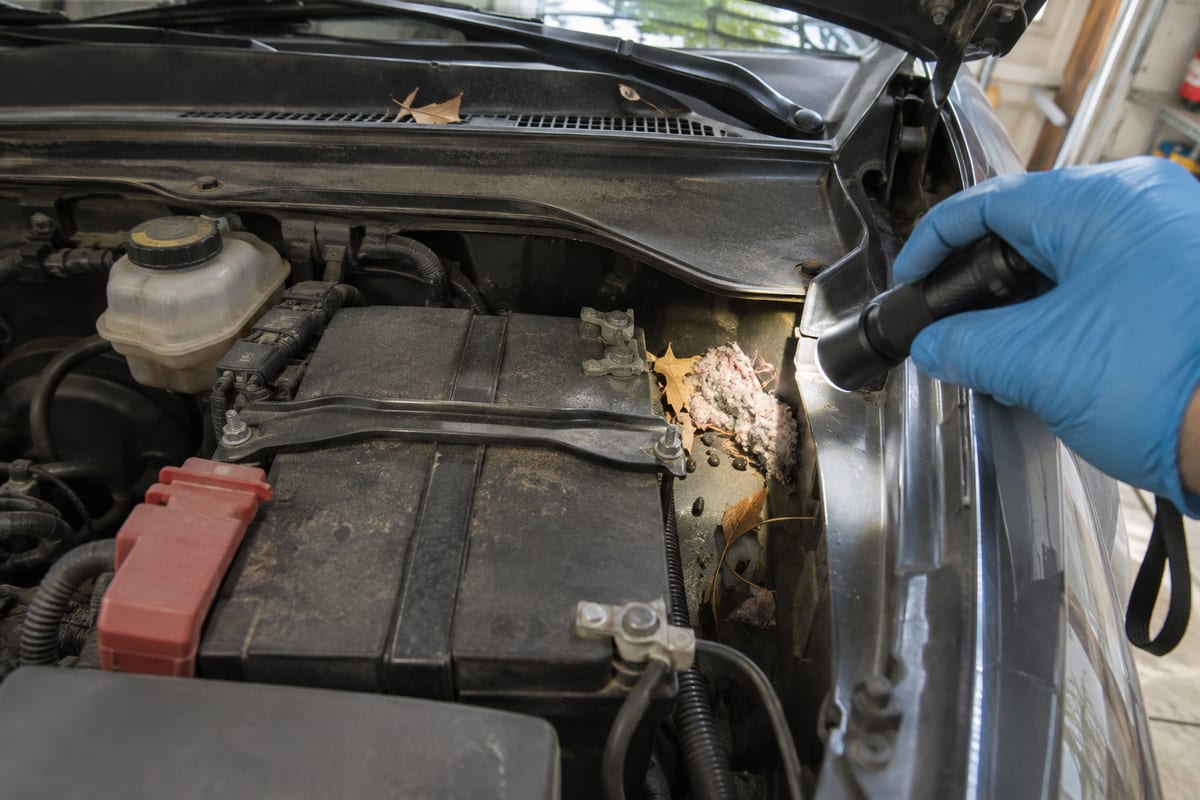
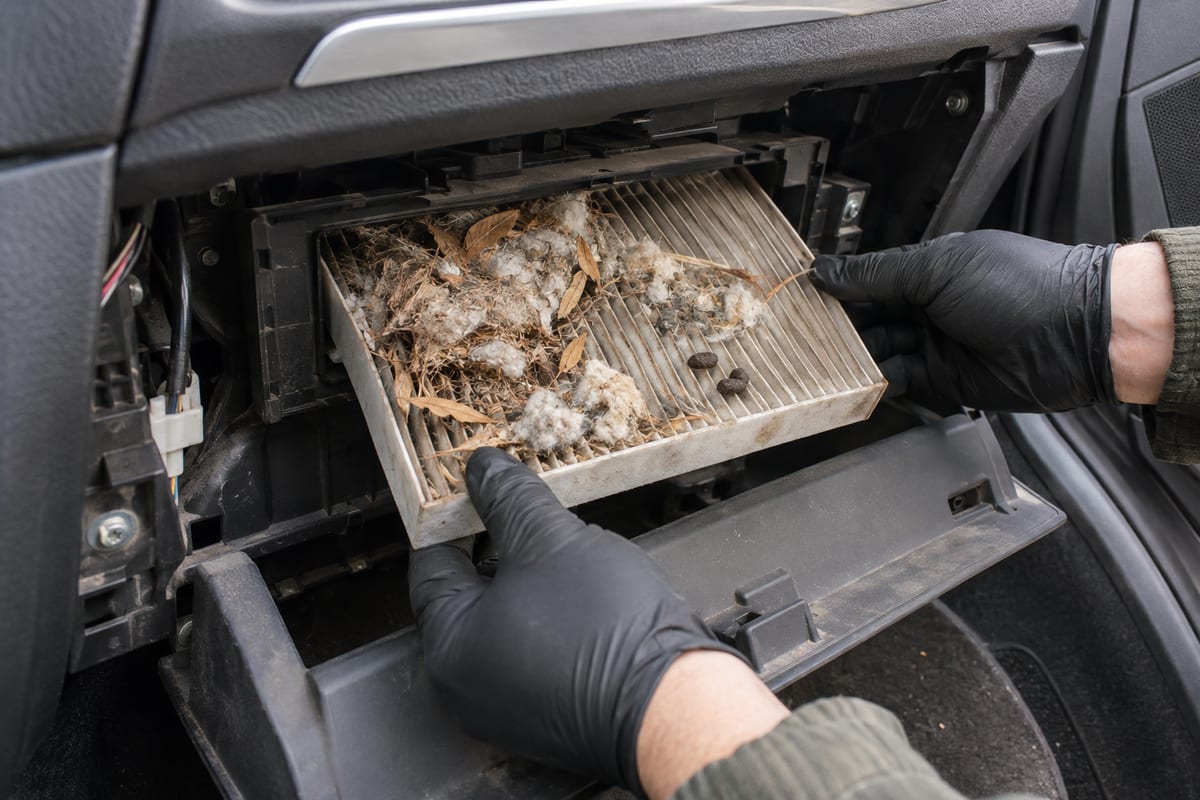
- Inspect the hot spots. Check between the battery and the frame near the wiper motor, under the air intake ducting, inside the engine air filter box, and behind the glove box where the cabin air filter sits.
- Soak, then remove. Spray droppings and nest material with disinfectant until fully wet, wait 5 minutes, then pick everything up with paper towels. No vacuum, no broom, no pressure washer.
- Replace contaminated filters. If the engine air filter or cabin air filter has nesting material in it, disinfect it, remove it, throw it away, and install a new one.
- Look for chewing damage. Check wiring insulation, vacuum hoses, and fluid lines. If anything is chewed, get a mechanic to inspect before regular driving.
- Set traps around the car tonight. Snap traps along garage walls and near the tires stop the next mouse before it climbs in.
Why mice pick your car: warmth, shelter, and food within 30 feet
Mice move into cars for the same reasons they move into houses. An extension pest specialist at the University of Maine told the Bangor Daily News that mice “tend to enter a car looking for shelter from snow and rain,” and that cars parked away from buildings in tall grass are especially vulnerable.
House mice don’t travel far. UC IPM notes they seldom go more than about 30 feet (9 m) from their nest and food. So if your car sits near a bird feeder, a pet food bag, a woodpile, or a weedy fence line, it’s inside a mouse’s normal daily range.
The engine bay gives them dark, sheltered spaces. The cabin offers soft seat foam, headliner material, and crumbs. A car that sits for days or weeks without moving is the easiest target, because nothing disturbs a nest in progress.
Where mice get into a car: gaps the width of a pencil
You can’t make a car mouse-proof. According to the UMaine extension specialist, mice “can squeeze through openings as small as the diameter of a pencil,” and the areas around vents, the steering column, and the pedals give them access to the interior. Most of the engine bay is open from below.
Public Health — Seattle & King County lists these common entry routes:
- Engine and body: rust holes, wire chases, side vents, rocker panels, and ducting.
- Passenger cabin: rusted areas, HVAC ducting, and cable passages through the firewall.
- Trunk: body holes, cable conduits, and in some models the gap behind the back seats.
Fix what you reasonably can. Have rust holes repaired, keep the cabin air filter installed (never run the car without it), and ask your mechanic whether a fine metal mesh screen can be fitted over the cabin air intake on your model. Don’t stuff steel wool or foam into vents or engine openings yourself. Blocking airflow or leaving loose material near hot parts can cause new problems.
Signs of mice in your car: droppings, nests, and a musty smell from the vents
You’ll usually spot a mouse problem before you see a mouse. Check for these signs, especially in fall and winter and after the car has been parked for a while.
| Where to look | What you'll see | What it means |
|---|---|---|
| Engine cover, battery tray, fender wells | Small dark droppings, shredded insulation, leaves, or paper | Mice are nesting or passing through the engine bay |
| Engine air filter box | Nest material, seeds, or nut shells on or in the filter | Nest inside the intake; filter needs replacing |
| Cabin air filter (often behind the glove box) | Chewed filter, droppings, stored food | Mice in the HVAC intake; dust can reach passengers |
| Air vents when the fan runs | Musty or urine-like smell, bits of debris | Possible nest in the blower or ducts |
| Floor mats, trunk, under seats | Droppings, chewed wrappers, torn seat foam | Mice inside the cabin, often after food |
| Dashboard | New warning lights, electrical glitches | Possible chewed wiring |
Source: Public Health — Seattle & King County, "Cleaning infested vehicles"; UC IPM Pest Notes: House Mouse.
UC IPM describes house mouse nests as built from “finely shredded paper or other fibrous material” and notes a musky odor in large or long-term infestations. In a car, that fibrous material is often hood insulation, seat stuffing, or tissues left in a door pocket.
Parked-car habits that keep mice away
Since sealing a car is limited, your parking habits do most of the work.
Take every crumb out of the car
Public Health — Seattle & King County says simply: don’t leave any food in the car. That includes fast-food bags, kids’ snacks, pet treats, birdseed bags in the trunk, and wrappers under the seats. Vacuum the cabin regularly (this is fine as routine cleaning when there’s no sign of mice; once you find droppings, switch to the wet-cleaning method below).
Park in the right spot
The UMaine specialist called a “secure, mouse-proof garage” the ideal. If you don’t have one, park on pavement away from tall grass, brush, woodpiles, and dumpsters. Mow and clear a strip around the place where the car sits.
If you do park in a garage, treat the garage as the real target. Seal gaps under the door, store pet food and birdseed in metal or heavy plastic bins with tight lids, and clear clutter along the walls. The same steps you’d use to seal gaps that let mice into your walls apply to a garage.
Drive it or check it
Mice nest in cars that sit. If a vehicle will be parked for weeks, such as a second car, an RV, or a car in winter storage, open the hood every week or two and look. Public Health — Seattle & King County advises airing out a long-idle vehicle and checking the air intake and filters before you start it.
Trap around the car, not just inside it
Snap traps along the garage walls and near the wheels catch mice on their way in. UC IPM recommends placing traps along walls, in dark corners, and where you’ve seen droppings, with only a small amount of bait on the trigger. If you have mice in the attic or house as well, deal with that population too, since the car is often just their overflow.
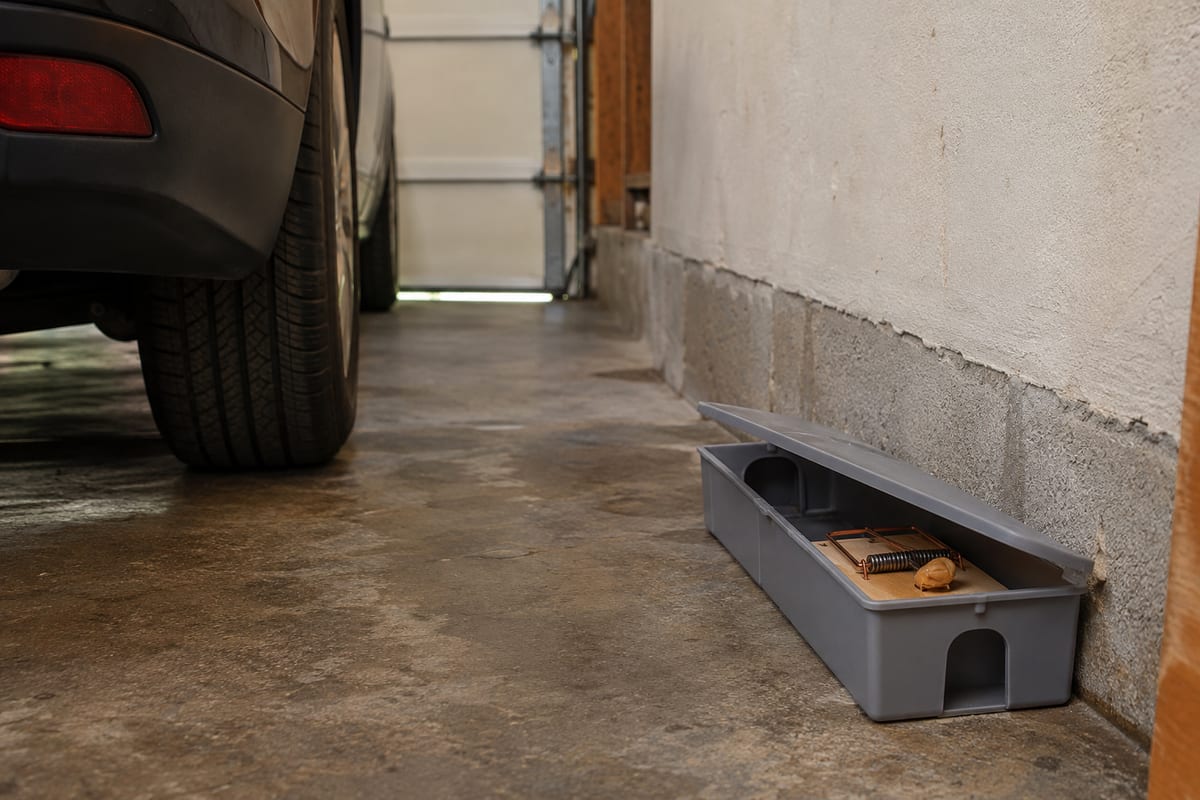
If you use rodenticide bait, note that EPA rules require consumer rodenticides to be sold in ready-to-use bait stations, and UC IPM adds that the stations must be tamper-resistant and placed out of reach of children, pets, and wildlife. Follow the label exactly. The label is the law. Never put loose bait inside the car or the engine bay, where a poisoned mouse may die somewhere you can’t reach.
What doesn’t work (and why)
Car forums are full of home remedies. Here’s how the popular ones hold up.
Ultrasonic repellers. UC IPM states plainly that “high frequency electronic devices aren’t effective” and that there is little evidence sound, magnetic, or vibrational devices drive established mice away. Mice also get used to regularly repeated sounds.
Mothballs under the hood. Mothballs are pesticides labeled for killing clothes moths in airtight containers. The National Pesticide Information Center says they “are not meant to be used as animal repellents” and have little effect as repellents. Using them in or around a car breaks the label, and the fumes end up in the space where you breathe.
Dryer sheets and peppermint oil. These are the most repeated tips online. We found no extension service or peer-reviewed study showing either one keeps mice out of a vehicle. Soft sheets can also become nest material.
Blaming soy-based wiring. Some sources claim newer cars use wire insulation that attracts rodents. That claim is disputed and unproven. Mice chew wires in older cars too, because they gnaw constantly and wires run through the sheltered spaces where they nest. Focus on keeping mice away rather than on the wire type.
Capsaicin-coated “rodent tape.” Hot-pepper tape is sold for wrapping wire harnesses, and some mechanics use it after a repair. We found no independent research on how well it works, so treat it as an optional extra over repaired wires, not as protection on its own.
Cleaning up mouse droppings in a car the CDC way
Mouse droppings, urine, and nests can carry hantavirus and other germs. The risk comes mostly from breathing dust when that material is stirred up, according to the CDC. Public Health — Seattle & King County also warns that particles in a car’s ventilation system can blow onto passengers.
Follow the CDC’s cleanup steps:
- Open the hood, doors, and trunk and let the car air out for 20 minutes. Stay out of it during that time.
- Put on rubber or plastic gloves. A long-sleeved shirt helps.
- Mix a fresh bleach solution: 1.5 cups of household bleach per 1 gallon of water (1 part bleach to 9 parts water), or use a registered disinfectant and follow its label. Don't mix bleach with any other cleaner.
- Spray droppings, urine spots, and nesting material until fully soaked. Let it sit 5 minutes, or as long as the disinfectant label says.
- Pick up the material with paper towels and throw it in the trash. Bag nests and dead mice, seal the bag, and put it inside a second bag.
- Disinfect the rest of the area again.
- Wash your gloved hands with soap and water or disinfectant, remove the gloves, then wash your hands with soap and warm water.
Don’t vacuum, sweep, or use compressed air or a pressure washer on droppings before they’re disinfected. Bleach can damage fabric and some interior plastics, so on seats and carpet use a disinfectant labeled for those surfaces.
For a nest inside the HVAC system, blower motor, or ducts, the cleanup is a mechanic’s job. Hoses, ducts, filters, and fans may need replacing. Tell the shop you found rodents so technicians can protect themselves.
When to call a professional
Call a mechanic if you see:
- Chewed wires, hoses, or fluid lines.
- New warning lights, electrical glitches, or a burning smell.
- A nest in the blower motor, ducts, or anywhere you can’t reach safely.
- A strong, lasting odor from the vents after you replaced the cabin air filter (often a dead mouse or nest deeper in the system).
Call a pest control professional if mice keep coming back after a few weeks of trapping, or if you’re seeing signs in the house and garage too. The car problem usually ends when the nearby population is under control. Check whether your auto insurance covers rodent damage. Coverage varies by policy, so ask your insurer directly.
Closing checklist
- No food, wrappers, pet food, or birdseed in the car.
- Park away from tall grass, brush, and woodpiles; keep the garage sealed and uncluttered.
- Open the hood and check the engine bay every week or two, especially in fall and winter.
- Check the engine air filter and cabin air filter for nests.
- Snap traps around the parking spot, covered from pets and kids.
- Skip ultrasonic devices and mothballs.
- Clean droppings wet: air out 20 minutes, soak 5 minutes, wipe, bag.
- Mechanic first for chewed wiring or a nest in the vents.
Frequently asked questions
What to do if there are mice in your car?
Park outside if you can, open the hood, doors, and trunk, and let the car air out for 20 minutes before you clean. Set snap traps around the car, then disinfect droppings and nests with a bleach solution instead of vacuuming them. If you smell burning, see warning lights, or find chewed wires, have a mechanic inspect the car before you drive far.
How do you know if you have mice in your car?
Look for small dark droppings on the engine cover, battery tray, or floor mats, shredded insulation or paper, and food stashes like seeds or acorn shells. A musty smell from the vents when you turn on the fan often means a nest in the cabin air filter or blower area. Chewed wiring can also trigger warning lights.
Can mice damage your car?
Yes. Mice chew wiring, hoses, and insulation, and nesting material can clog air filters and the blower. Public health agencies also warn that mice in the ventilation system can blow contaminated dust onto passengers.
Do dryer sheets or peppermint oil keep mice out of cars?
We found no extension service or peer-reviewed study showing that dryer sheets or peppermint oil keep mice out of a vehicle. Mice also use soft material for nests, so a dryer sheet can end up as nesting material. Food removal, parking habits, and trapping are the methods with real support.
Does leaving the hood up keep mice away?
Leaving the hood open removes some of the dark, sheltered space mice like, and it is a common suggestion, but there is no research showing it works on its own. Treat it as a minor extra, not a replacement for removing food and trapping around the car.
Can I get hantavirus from mice in my car?
Hantavirus is rare, but it spreads mainly by breathing dust from rodent urine, droppings, or nests. That is why the CDC says to air out the car and soak droppings with disinfectant before removing them, and never to vacuum or sweep them dry.
Sources
- CDC — How to Clean Up After Rodents
- Public Health — Seattle & King County: Cleaning infested vehicles
- UC IPM Pest Notes — House Mouse
- Bangor Daily News — Keeping rodents out of your car (interview with UMaine Cooperative Extension)
- National Pesticide Information Center — Mothballs FAQ
- CDC — Preventing Hantavirus
- U.S. EPA — Restrictions on Rodenticide Products
- U.S. EPA — Introduction to Pesticide Labels